- Choose Group-IB Digital Risk Protection when you want analysts to validate brand abuse and manage takedowns across domains, social networks, apps and marketplaces. 1–2
- Choose Have I Been Squatted to detect malicious domains with rules your team edits, block them in your gateways, and see whether they are set up for email or appear in your mail. 3–15
- Use both when Group-IB manages wider brand abuse and your security team wants its own domain rules, with one agreed owner for overlapping domain cases. 1–2,4–7,9–12
At a glance#
| Have I Been Squatted | Group-IB | |
|---|---|---|
| What you get | ||
| What you get | Detection and response for malicious domains3 | Managed digital risk protection across many channels1 |
| Lookalike discovery | ||
| Lookalike discovery | Domain databases and typosquatting monitoring2 | |
| Who reviews findings | ||
| Who reviews findings | Your team reviews alerts and sets their status16–17 | Group-IB analysts supervise and review detections1–2 |
| Response in your tools | ||
| Response in your tools | ||
| Managed takedowns | ||
| Managed takedowns | Domains, to host and registrar, with escalation22–25 | Domains, social, apps, marketplaces, ads, messengers1–2 |
| Beyond domains | ||
| Beyond domains | Not covered: social, apps, dark web26–27 | Social, apps, dark web, ads, marketplaces, messengers1–2 |
| How you buy | ||
| How you buy | ||
Coverage beyond lookalike domains#
Group-IB Digital Risk Protection is a managed brand-protection service that reaches well past domains. Group-IB states that it monitors domains, scam and phishing databases, advertising, search results, social media, marketplaces, mobile stores and messengers, and that it works in any language. Data Leak Detection adds paste sites, the dark web and code repositories, and VIP Protection monitors and mitigates fake accounts for executives. A Group-IB methods article also describes anti-counterfeiting and anti-piracy modules. A brand, fraud or security team can hand all of that to one vendor. 1–2,29
Have I Been Squatted concentrates on domains and the threats built on them. Domain Monitoring generates lookalikes and watches certificate transparency and newly registered domains. Email Intelligence adds mail telemetry from Microsoft 365 and Google Workspace, and Site Canaries flag copies of your own pages. Have I Been Squatted does not monitor social media, app stores, the dark web, ads or leaked credentials. 13–16,25–27,30
How each product investigates a lookalike domain#
Group-IB builds detection around its analysts. Domain monitoring covers domain databases and typosquatting, and Group-IB describes finding suspicious newly registered domains linked to other suspicious resources. Evidence collection includes screenshots, HTML files, redirect chains, traffic sources and domain-related parameters, and a vendor investigation says analysts used logo analysis and text recognition on the platform. Analysts supervise detection around the clock and analyze detected violations by hand. No public documentation of certificate transparency monitoring or of a customer-searchable domain dataset was found for Digital Risk Protection. 1–2,20,28–29,31–32
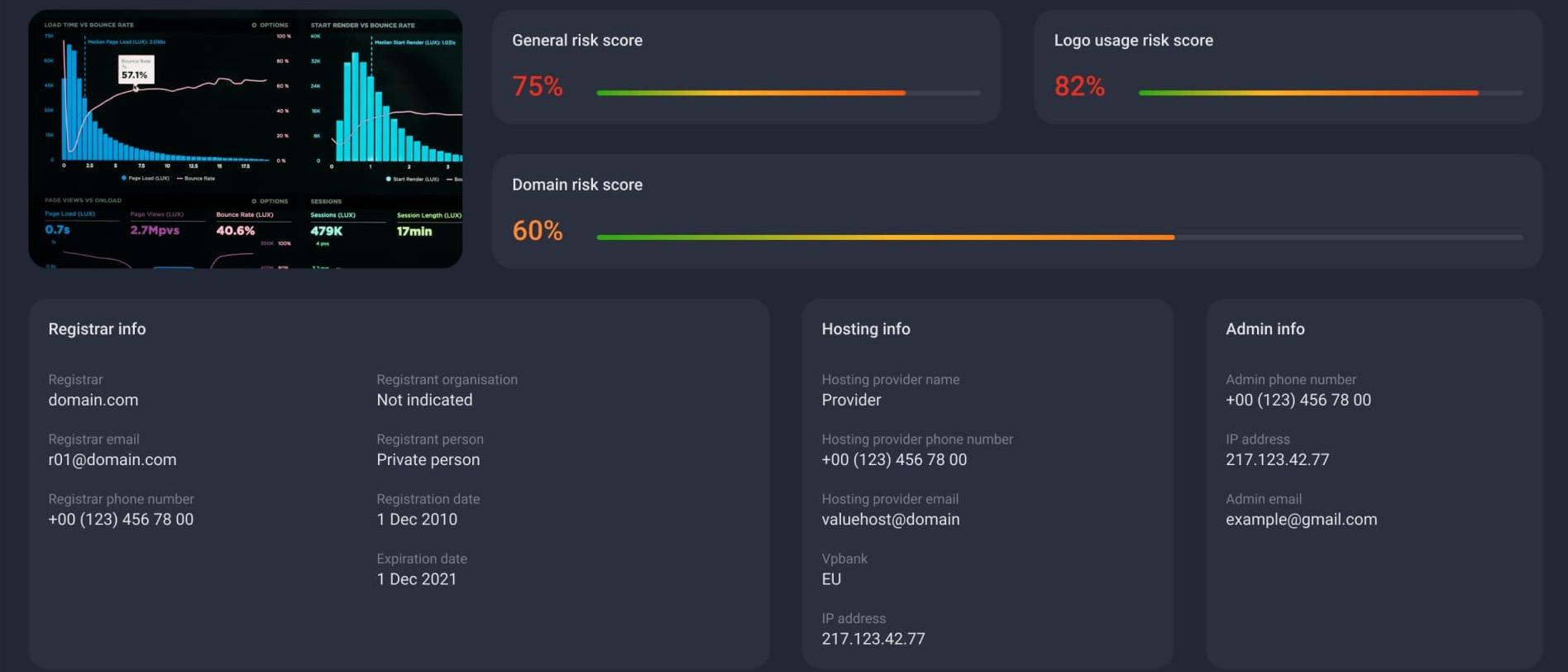
Group-IB also correlates related infrastructure. Its Graph view links a suspect domain to IPs, contacts, malware and social accounts, and the vendor describes network graphs and auto-attribution that draw on Group-IB Threat Intelligence. Group-IB markets DNS patterns, WHOIS data, IP behavior and phishing-kit fingerprints as infrastructure signals. 1–2,21,28–29,33–34
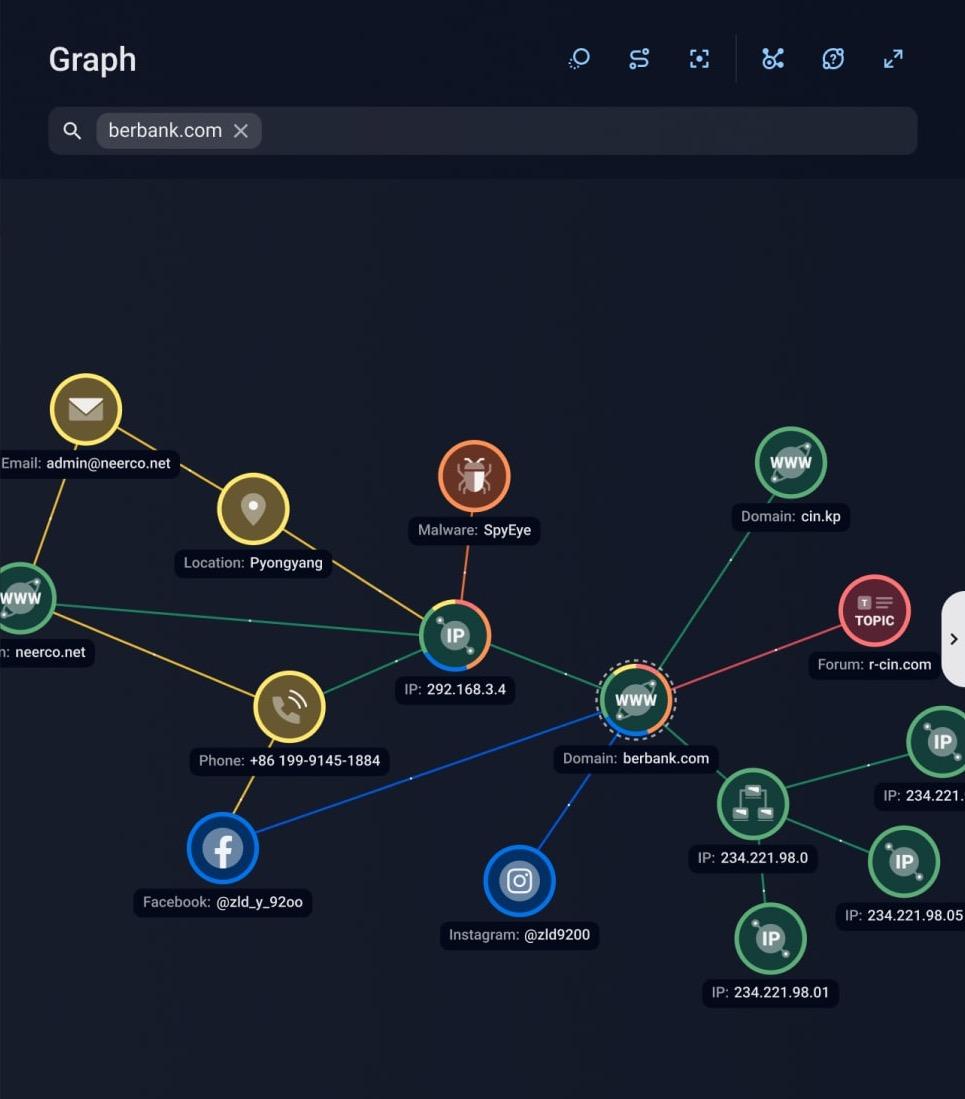
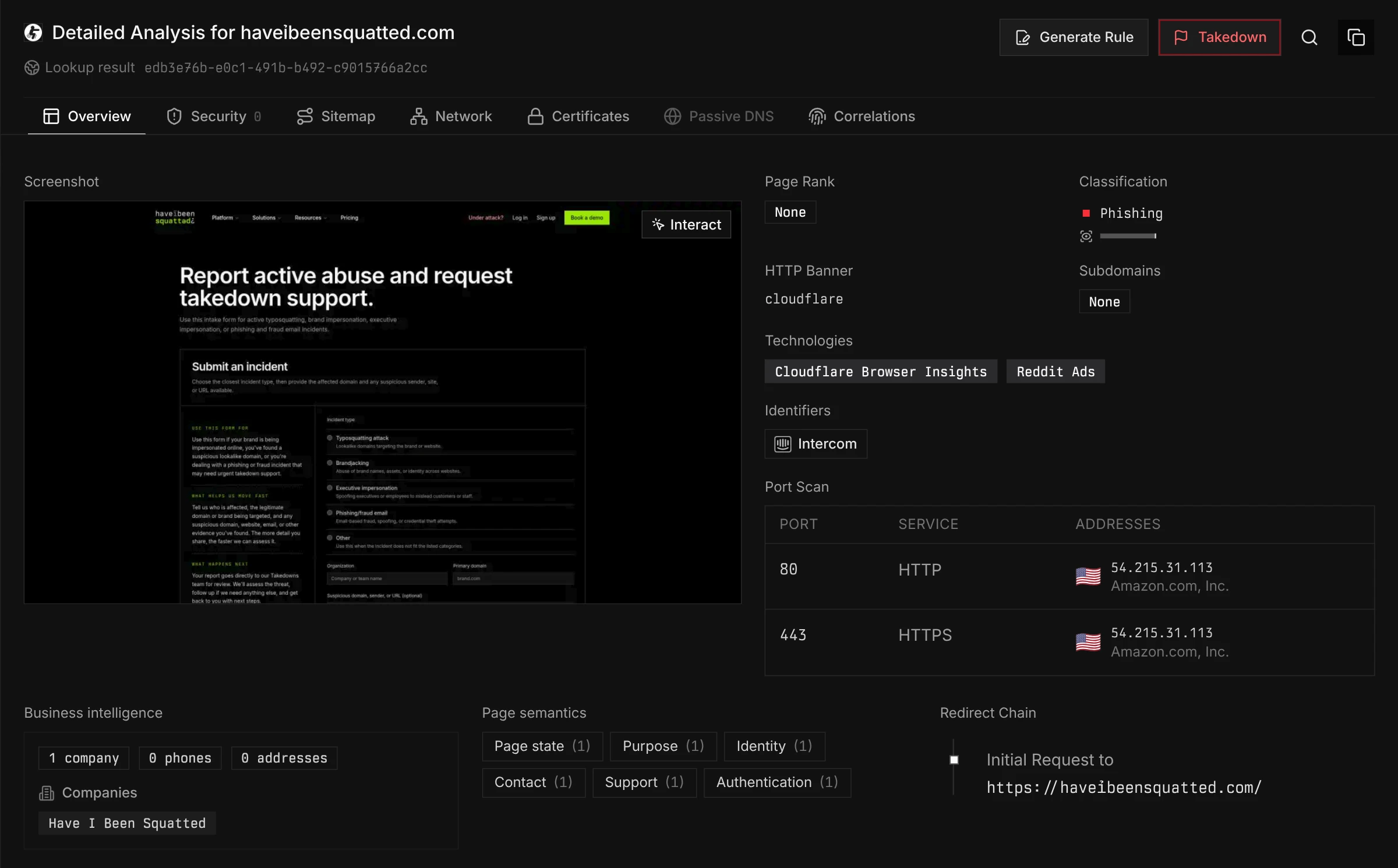
Have I Been Squatted gives your analysts the domain evidence to inspect. Domain Monitoring finds lookalikes from generated permutations, such as homoglyphs, bitsquats and TLD swaps, and from certificate transparency and newly registered domains. Results can include RDAP registration data, hosting details, DNS records, mail readiness, open ports and a capture of the website, where those signals are available. An analyst can check whether a lookalike resolves, is set up for email or serves a copied page, then open it in an isolated browser. For managed help beyond Takedowns, Have I Been Squatted offers a Managed Threat Intelligence service through sales. 5–6,13,16,25,35–41
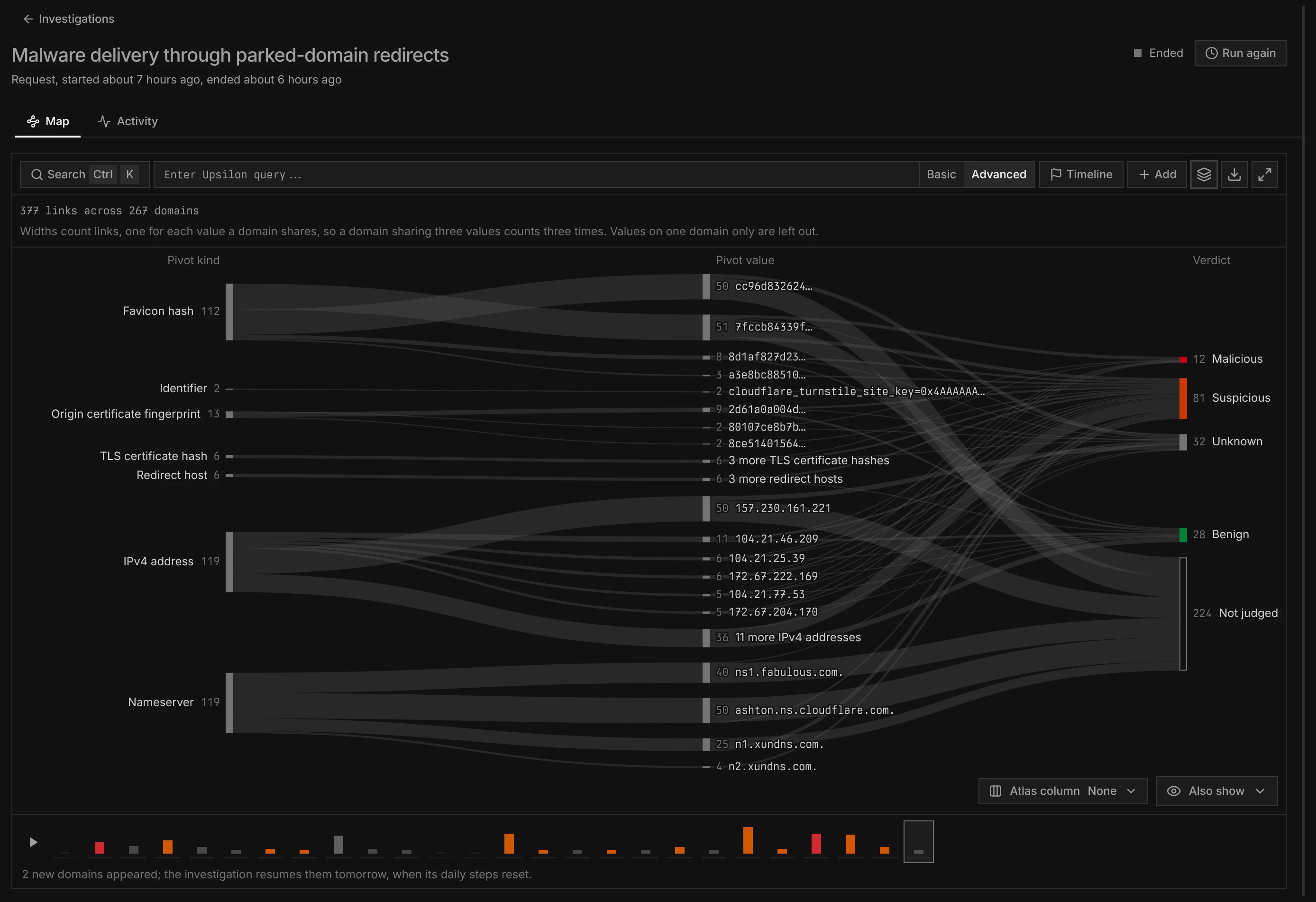
Have I Been Squatted maps the infrastructure around a suspect domain with Atlas investigations, which are in early access and enabled on request. An investigation starts from a described hunt, optionally with domains you already suspect, and pivots across shared infrastructure in Atlas, the store of domain observations. Results appear in views such as Tree, Table, Clusters and Flows, and export to STIX 2.1, CSV or JSON. The investigation keeps running after the first pass, and every six hours it reruns its name searches and re-checks its rarest values. 23,39–40,42–45
Acting on a finding in your own tools#
Group-IB connects Digital Risk Protection to security operations tooling. Its integrations directory lists Splunk ES, IBM Security QRadar SIEM, Google SecOps and StrikeReady. Group-IB includes unlimited users and API access, with a REST API, Postman configuration and a Python library. An in-product Service Desk handles tickets between the customer and Group-IB. A vendor Google SecOps playbook example can send chat notifications and optionally direct existing controls to block a malicious domain or IP. 2,20–21,28
Have I Been Squatted puts response in rules that run over domain signals. A maintained rules library covers common detections, and your team can add its own rules. A rule can raise an alert, deliver the finding to a SIEM, push the domain to a block list, mark the result Malicious with a note or request a Takedown. Network Enforcement sends flagged domains to gateways, endpoints, mail filters and a hosted domain feed, and an MCP server lets agents work the same alerts and Takedowns, with every write gated to an admin. No public documentation of customer-editable rules was found for Digital Risk Protection. 1,4–12,18–19,25,44,46–49
Takedowns
Follow a Takedown from request to outcome.
A demo shows the Takedown case workflow and the Network Enforcement gateways that receive blocks.
Managed takedowns and their targets#
Both products offer managed takedowns. Group-IB runs a three-stage process of notification, enforcement and cease-and-desist, offers unlimited takedowns, and requires a power of attorney from the trademark owner before it blocks brand infringements. Group-IB states that, as a trusted party for some domain zones, it can take domains down in minutes through a domain-zone API, and its leaflet advertises an 85% average pretrial takedown rate. CERT-GIB is a FIRST and Trusted Introducer member, and Group-IB is an APWG member. 1–2,28,33,50
Group-IB reaches more kinds of target. Its partnership network includes domain registrars, hosting providers, domain zone authorities and administrators of large websites, and Group-IB also handles enforcement on social networks, marketplaces, ad networks, app stores including gray stores, and messengers. While a takedown runs, Group-IB states that it can block victim traffic in as little as three minutes through browser-level blocking and DNS suppression. 1–2,28
Have I Been Squatted runs managed Takedowns for domains. An admin requests one from a lookup result or an alert, or a rule opens the request automatically, and an analyst reviews every request. The team reports the domain to its host and registrar, then escalates to ICANN and regional CSIRTs where necessary. The service stops short of legal action and can introduce legal partners. 22–25
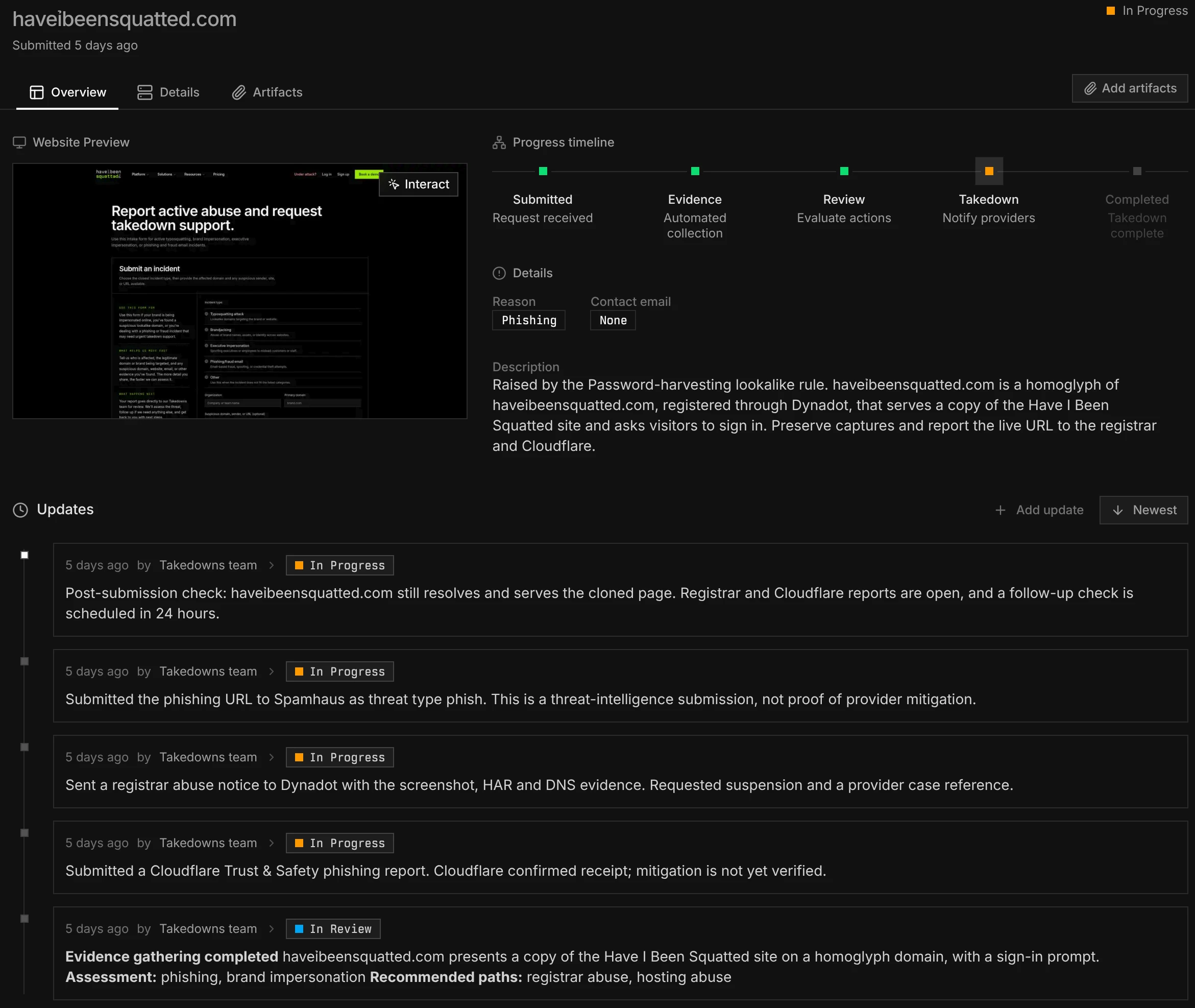
Choose Group-IB when a case can move from a domain to a social profile, an app, an ad or a marketplace listing, and when cease-and-desist escalation belongs in the same engagement. Choose Have I Been Squatted when the case is a malicious domain and you want the Takedown tied to the monitoring and rules that found it. With either vendor, ask who follows up when a provider does not act and how you see the progress of each case. 1–2,4–7,22–25
Where Group-IB is the better choice#
Group-IB Digital Risk Protection fits when digital risk spans channels that a domain product does not cover. Social impersonation, rogue apps, marketplace listings, messenger abuse and leaked data sit in one managed service, with VIP Protection for executive impersonation. Analysts supervise detections around the clock and review suspected violations, and a dedicated customer success manager supports the engagement. 1–2
It also suits buyers who want actor attribution and multi-channel enforcement handled for them, including domain-zone API takedowns, cease-and-desist escalation and traffic blocking while removal proceeds. Group-IB reports Frost Radar recognition as a Visionary Leader for enterprise risk mitigation and management platforms, and earlier Frost & Sullivan coverage of its European digital risk protection share. Direct purchases are quote-based through sales or a private offer on AWS Marketplace. 1–2,28,33–34,51
Where Have I Been Squatted is the better choice#
Have I Been Squatted suits a security team that wants to own detection and response for malicious domains and the infrastructure behind them. Your analysts write rules in the Upsilon query language, or start from the maintained library, over a catalog of 173 domain signals. A matching rule can send the finding to Splunk or Google SecOps, block the domain in Zscaler, Cloudflare Zero Trust or Microsoft Defender for Endpoint, or request a managed Takedown. Network Intelligence then shows whether devices on your network connected to a flagged domain. 3–12,18–19,25,52
It also covers the mail side of an attack. Results show MX records and an SMTP banner where the domain has them, so an analyst knows which domains are set up for email. Email Intelligence correlates Microsoft 365 and Google Workspace mail telemetry, including sender and URL domains, with your monitored domains. Site Canaries flag your own pages when they load on a hostname you have not approved. No public documentation of mail-readiness checks, a mailbox integration or cloned-site detection was found for Digital Risk Protection. Group-IB sells mail protection as a separate product, Business Email Protection. 1–2,5,13–15,20,28,30,32,53
Buying does not start with a quote. Domain Monitoring checks your domains continuously, and monitoring, hunting tools, rules and alerts are self-serve with a free trial. Takedowns and the email, network, SIEM and canary products are bought through sales. Reports go out as a PDF "Domain security overview" or "Compliance readout", with CSV and JSON exports alongside. Have I Been Squatted has a SOC 2 Type II report, available through its Trust Center, and stores and processes data in the United States. Single sign-on and audit logging are available. 4,13,16–17,23,25,39,41,44–47,52,54
Have I Been Squatted does not suit a buyer who wants one vendor for every channel where the brand appears. Group-IB covers that remit as a managed digital risk protection service. Have I Been Squatted also does not take legal action, so a team that wants cease-and-desist work inside the service needs a legal partner beside it. 1–2,25–27
FAQ#
It can, if you want analysts to supervise detections for you. Group-IB Digital Risk Protection monitors domain databases and typosquatting, with analysts supervising detections. Compare that managed workflow with Have I Been Squatted's domain rules, enrichment and connector actions to decide which fits how your team works. 1–2,4–7,9–12
Yes, both run managed takedowns with analyst involvement. Group-IB covers more targets beyond domains, describes domain-zone API removals and traffic blocking while work proceeds, and can escalate to cease-and-desist. Have I Been Squatted takes requests from a lookup result, an alert or a rule, reports each domain to its host and registrar, and escalates where necessary. 1–2,22–25,28,50
Choose Have I Been Squatted if your team wants to start with a self-serve trial and run domain investigations and rules itself. Consider Group-IB if analyst supervision and multi-channel managed protection matter more than self-serve buying, especially when your remit reaches past domains. 1–2,4–7,13,25
OpenSanctions lists Group-IB Global Private Limited on the Ukraine NSDC sanctions register, and its search found no US, EU or UK listing for Group-IB. Buyers whose contracting is subject to Ukrainian sanctions should confirm which Group-IB entity signs the agreement and check the register with counsel. 56–59
Sources and corrections
Each numbered marker on this page links to its sources below. Each source shows the date it was last checked. If a fact is wrong or out of date, send a correction. A correction is checked against the source and the page is updated.
- 1.Group-IB. “Digital Risk Protection & Digital Brand Protection Services.” Accessed . https://www.group-ib.com/products/digital-risk-protection/
- 2.Group-IB. “Product feature matrix: Digital Risk Protection.” Accessed . https://www.group-ib.com/subscriptions/digital-risk-protection/
- 3.Have I Been Squatted. “Homepage (footer tagline).” Accessed . https://haveibeensquatted.com/
- 4.Have I Been Squatted. “Rules engine guide.” Accessed . https://docs.haveibeensquatted.com/guides/rules-engine/
- 5.Have I Been Squatted. “Domain signals.” Accessed . https://docs.haveibeensquatted.com/reference/signals/domain/
- 6.Have I Been Squatted. “Changelog.” Accessed . https://haveibeensquatted.com/changelog
- 7.Have I Been Squatted. “Network Intelligence guide.” Accessed . https://docs.haveibeensquatted.com/features/network-intelligence/
- 8.Have I Been Squatted. “Integrations.” Accessed . https://haveibeensquatted.com/platform/integrations
- 9.Have I Been Squatted. “Network Enforcement.” Accessed . https://haveibeensquatted.com/platform/network-enforcement
- 10.Have I Been Squatted. “Domain feed integration.” Accessed . https://docs.haveibeensquatted.com/integrations/domain-feed/
- 11.Have I Been Squatted. “CrowdStrike Falcon integration.” Accessed . https://docs.haveibeensquatted.com/integrations/crowdstrike-falcon/
- 12.Have I Been Squatted. “Microsoft Defender for Endpoint integration.” Accessed . https://docs.haveibeensquatted.com/integrations/microsoft-defender-endpoint/
- 13.Have I Been Squatted. “Domain Monitoring.” Accessed . https://haveibeensquatted.com/platform/monitoring
- 14.Have I Been Squatted. “Email Intelligence.” Accessed . https://haveibeensquatted.com/platform/email-intelligence
- 15.Have I Been Squatted. “Email Intelligence guide.” Accessed . https://docs.haveibeensquatted.com/features/email-intelligence/
- 16.Have I Been Squatted. “Domain monitoring guide.” Accessed . https://docs.haveibeensquatted.com/features/domain-monitoring/
- 17.Have I Been Squatted. “Administration guide.” Accessed . https://docs.haveibeensquatted.com/guides/administration/
- 18.Have I Been Squatted. “Alert digest guide.” Accessed . https://docs.haveibeensquatted.com/guides/digest/
- 19.Have I Been Squatted. “Connectors.” Accessed . https://docs.haveibeensquatted.com/integrations/
- 20.Group-IB. “Integrations.” Accessed . https://www.group-ib.com/integrations/
- 21.Group-IB. “Group-IB Digital Risk Protection Integrates with Google SecOps (2026-05-08).” Accessed . https://www.group-ib.com/blog/drp-secops-integration/
- 22.Have I Been Squatted. “Takedowns.” Accessed . https://haveibeensquatted.com/platform/takedowns
- 23.Have I Been Squatted. “Takedowns guide.” Accessed . https://docs.haveibeensquatted.com/features/takedowns/
- 24.Have I Been Squatted. “FAQ (stalled takedowns).” Accessed . https://haveibeensquatted.com/faq#takedowns-stall
- 25.Have I Been Squatted. “Pricing FAQ (takedowns).” Accessed . https://haveibeensquatted.com/pricing
- 26.Have I Been Squatted. “Solutions.” Accessed . https://haveibeensquatted.com/solutions
- 27.Have I Been Squatted. “Brand protection.” Accessed . https://haveibeensquatted.com/solutions/brand-protection
- 28.Amazon Web Services (vendor-supplied content). “Group-IB Digital Risk Protection (AWS Marketplace listing, with G2 reviews).” Accessed . https://aws.amazon.com/marketplace/pp/prodview-abbhx7et5nmpi
- 29.Group-IB. “Digital Risk Protection: violation detection and takedown (2024-07-15).” Accessed . https://www.group-ib.com/blog/digital-risk-protection/
- 30.Have I Been Squatted. “Site Canaries guide.” Accessed . https://docs.haveibeensquatted.com/features/site-canaries/
- 31.Group-IB. “Venomous vacancies (2023-03-21).” Accessed . https://www.group-ib.com/media-center/press-releases/venomous-vacancies/
- 32.Group-IB. “Anti-Phishing Solutions for Email, Web, and Social.” Accessed . https://www.group-ib.com/solutions/phishing-and-scam-protection/
- 33.Group-IB. “About Group-IB.” Accessed . https://www.group-ib.com/about-us/
- 34.Group-IB. “Group-IB named a Visionary Leader in 2026 Frost Radar for Enterprise Risk Mitigation and Management Platforms.” Accessed . https://www.group-ib.com/media-center/press-releases/frost-radar-2026-visionary-leader/
- 35.Have I Been Squatted. “Atlas observations: registration data by TLD.” Accessed . https://mcp.haveibeensquatted.com/mcp
- 36.Have I Been Squatted. “Platform.” Accessed . https://haveibeensquatted.com/platform
- 37.Have I Been Squatted. “Passive DNS guide.” Accessed . https://docs.haveibeensquatted.com/features/passive-dns/
- 38.Spamhaus. “Spamhaus passive DNS endpoint, unauthenticated probe.” Accessed . https://beta-pdns.spamhaus.com/api/v3/login
- 39.Have I Been Squatted. “Atlas investigations.” Accessed . https://docs.haveibeensquatted.com/features/atlas-investigations/
- 40.Have I Been Squatted. “Atlas investigations (add domains and indicators).” Accessed . https://docs.haveibeensquatted.com/features/atlas-investigations/#steer-an-investigation
- 41.Have I Been Squatted. “Access control reference.” Accessed . https://docs.haveibeensquatted.com/reference/access-control/
- 42.Have I Been Squatted. “Atlas investigations (shareable view links).” Accessed . https://docs.haveibeensquatted.com/features/atlas-investigations/#read-the-map
- 43.Have I Been Squatted. “Atlas investigations (New investigation flow).” Accessed . https://docs.haveibeensquatted.com/features/atlas-investigations/#start-an-investigation
- 44.Have I Been Squatted. “Reports guide.” Accessed . https://docs.haveibeensquatted.com/features/reports/
- 45.Have I Been Squatted. “Explore guide.” Accessed . https://docs.haveibeensquatted.com/features/explore/
- 46.Have I Been Squatted. “Agents.” Accessed . https://haveibeensquatted.com/platform/agents
- 47.Have I Been Squatted. “MCP server.” Accessed . https://docs.haveibeensquatted.com/ai/mcp/
- 48.Have I Been Squatted. “Slack app.” Accessed . https://docs.haveibeensquatted.com/ai/slack/
- 49.Have I Been Squatted. “MCP server (OAuth scopes).” Accessed . https://docs.haveibeensquatted.com/ai/mcp/#oauth-scopes
- 50.Group-IB. “Digital Risk Protection leaflet, page 5 (image only; read visually).” Accessed . https://go.group-ib.com/hubfs/leaflet/group-ib-drp-en.pdf
- 51.Group-IB. “Group-IB granted Innovation Excellence award from Frost & Sullivan for Digital Risk Protection (2021-01-27).” Accessed . https://www.group-ib.com/media-center/press-releases/drp-frost-and-sullivan/
- 52.Have I Been Squatted. “Network Intelligence.” Accessed . https://haveibeensquatted.com/platform/network-intelligence
- 53.Have I Been Squatted. “Site Canaries.” Accessed . https://haveibeensquatted.com/platform/site-canaries
- 54.Have I Been Squatted. “Security.” Accessed . https://haveibeensquatted.com/about/security
- 55.Have I Been Squatted. “Webhooks.” Accessed . https://docs.haveibeensquatted.com/integrations/webhooks/
- 56.Security Affairs. “President Zelensky imposes sanctions against the Russian IT sector.” Accessed . https://securityaffairs.com/146293/cyber-warfare-2/president-zelensky-sanctions-russia-it-sector.html
- 57.OpenSanctions (aggregating Ukraine NSDC register). “Group-IB Global Private Limited.” Accessed . https://www.opensanctions.org/entities/NK-HGBMNx9XYyX53ZWnY5hCiv/
- 58.Group-IB. “Group-IB exits Russia (2023-04-20).” Accessed . https://www.group-ib.com/media-center/press-releases/group-ib-exits-russia/
- 59.TÜV Austria. “ISO/IEC 27001:2022 certificate TA420243018927.” Accessed . https://www.group-ib.com/wp-content/uploads/tuv-austria-certificate-iso270012022-upd-1.pdf