Short answer#
- Scan on your own machine: dnstwist generates and resolves lookalikes of one domain, with optional page-similarity scores. 1–6
- Check once in a browser: Typosquatting finder (CIRCL) lists registered lookalikes in a browser, with no install. 7–8
- Repeat checks without running anything yourself: Have I Been Squatted, CheckPhish and dnstwister watch your domains and send alerts. Have I Been Squatted also turns findings into blocks and Takedown requests with rules. 9–18
- Hand removal to a vendor across many channels: Bolster, Netcraft, Red Points or ZeroFox run takedowns for domains, social media, app stores and more. 19–54
- Hunt lookalikes inside an investigation platform: DomainTools Iris Detect or Silent Push, when your analysts already work in that data. 55–58
A typosquatting detection tool takes a brand domain, or brand keywords, that you name. It then finds registered lookalike domains and reports them. dnstwist prints one run's output, Have I Been Squatted sends a scheduled alert, and ZeroFox analysts work a case for you. Phishing URL feeds, DNS filters, email security, package-registry checkers, visitor-side browser warnings and bulk data feeds that take no brand input are out of scope. This page compares a selection of these tools, grouped by how you run them. 6,10,29–30,59
Local scan
Runs on your machine against the domains or keywords you supply
You supply the schedule and storage
Browser check
Runs one check in a browser with no install
You repeat checks by hand
- Typosquatting finder (CIRCL)
- dnstwist.it (dnstwist's own page)
- dnstwister
- Have I Been Squatted (sign-in needed)
Self-serve monitoring
The service repeats checks and sends alerts
You sign up and review alerts
Managed service
A vendor team detects, reviews and takes down
You authorize and review the vendor's response
Investigation platform
Lookalike monitors inside a threat data platform
Your analysts work the results
Certificate feeds and search datasets
Certificate transparency sources and dataset searches. They supply data to a lookalike workflow; you supply the query or the keywords.
- crt.sh
- CertStream
- Phishing Catcher
- Censys
- urlscan.io
- VirusTotal
Local scan#
These five tools run on your machine, and their source is public. You supply the schedule, the storage and, apart from DNSRazzle's email report, the alert routing. dnstwist comes first because DNSRazzle and dnstwister build on its engine. 1–3,6,60–65
| How it finds candidates | Page comparison | Operating constraint | |
|---|---|---|---|
| dnstwist | |||
| dnstwist | One domain per run; no scheduler6 | ||
| URLCrazy | |||
| URLCrazy | Typo and word-level variants of one domain, then DNS68–70 | Not found70–71 | |
| urlinsane | |||
| urlinsane | Typosquat variants of one seed; multilingual on master75–77 | Content ssdeep in release 0.8.2; not found on master78–79 | |
| DNSRazzle | |||
| DNSRazzle | dnstwist-based permutations of many domains per run82–83 | SSIM screenshot comparison against the original83–84 | |
| openSquat | |||
| openSquat | Keyword match against a daily newly registered domain feed86–92 | Default feed: personal and research use only94 | |
dnstwist#
Best for a security engineer who wants a scanner they run, script and self-host. 1–3
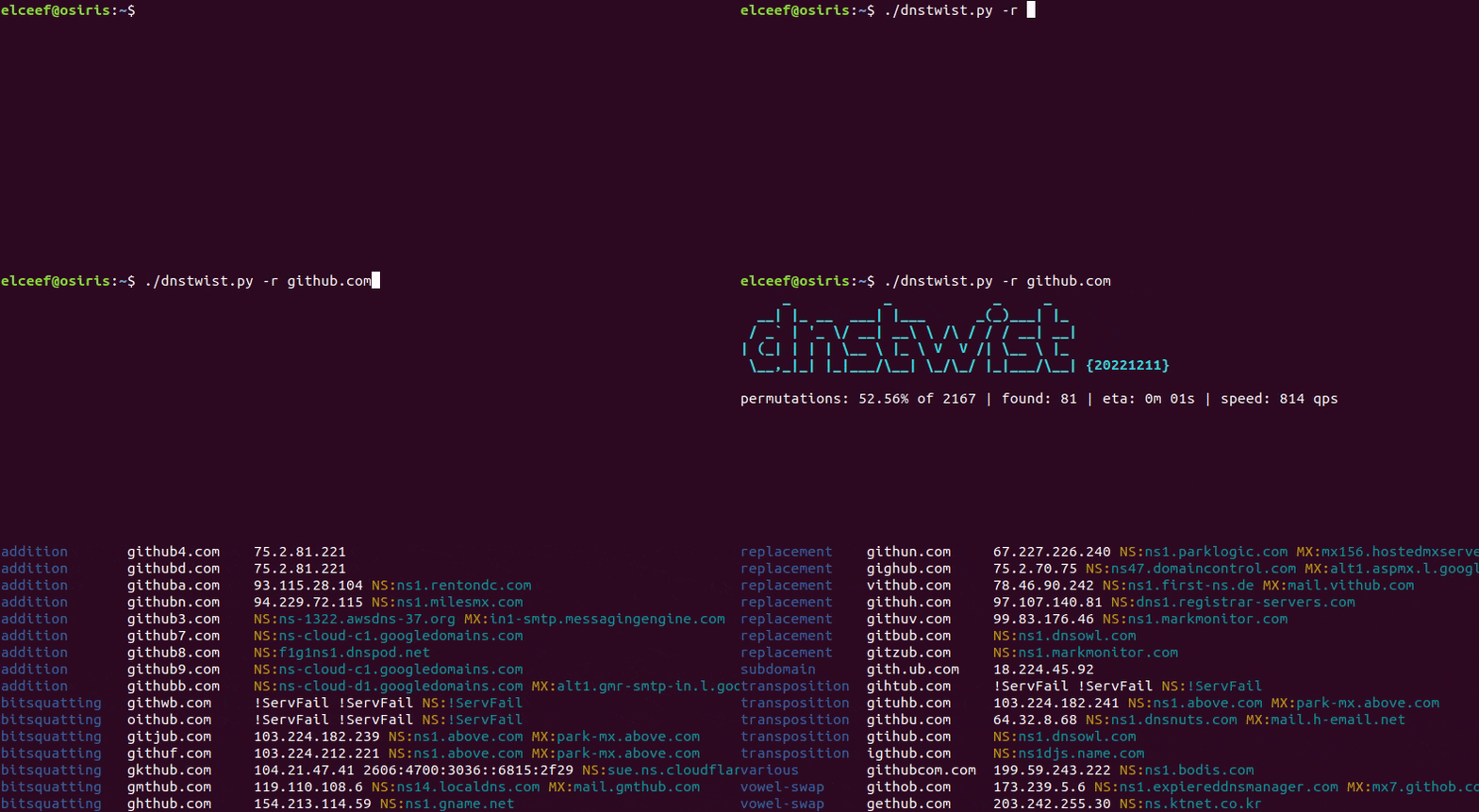
dnstwist is a domain permutation engine for detecting homograph phishing, typosquatting and brand impersonation. One run takes one domain, generates permutations and resolves each one. The fuzzer set covers keyboard layouts, bitsquatting, per-TLD IDN glyph rules, and dictionary and TLD files. Output goes to CSV, JSON or a bare list, lookups can use a custom or DNS-over-HTTPS resolver, and a Python API suits scripted runs. 1,3,6,66–67
Optional checks go past DNS. dnstwist scores page similarity with ssdeep or TLSH on the HTML and with a screenshot hash, each as a percentage, and saves the screenshots to disk. The opt-in --mxcheck probe flags lookalike mail servers that accept an SMTP session, --whois adds the creation date and registrar, and --banners adds HTTP and SMTP banners. The maintainer reports use by tens of SOC and incident response teams, and the README lists integrations such as a Splunk add-on and Maltego. 1,3–6,67,95
Marcin Ulikowski maintains dnstwist, open source and free under Apache License 2.0. The latest release shipped in January 2025. The last commit landed in April 2025, and the repository is not archived. dnstwist.it runs a quick scan in a browser. Install it from the dnstwist repository, and read Have I Been Squatted vs dnstwist. 1–3,6,96–100
URLCrazy#
Best for a penetration tester or analyst who wants misspelling and TLD breadth from one command. 68–69,101–103
URLCrazy takes one domain, generates variants and resolves each one. Word-level generators cover common misspellings, homophones and singular or plural forms, and -k selects a QWERTY, AZERTY, QWERTZ or Dvorak layout. Wrong TLD walks 1,513 TLDs, and All SLD adds country second-level domains in the same run. -f and -o write CSV or JSON to a file. 68–70,101–105
URLCrazy installs locally with no service account, and -r skips DNS resolution. Optional -p, off by default, asks a search engine for result counts, which the project presents as an estimate of how popular a typo is. Andrew Horton maintains URLCrazy, and the README dates its first publication to 2009. Kali Linux packages it, and Repology lists packages for Parrot, BlackArch and the AUR. 68,70–72,74,106–110
The license is a custom Restricted license, not an OSI-approved one. It allows use and distribution, but modified versions need the maintainer's permission, and a commercial service other than penetration testing, such as domain protection for clients, needs a separate license. The last release shipped in July 2025, with no later commit by November 2026. Install it from the URLCrazy repository, and read Have I Been Squatted vs URLCrazy. 68,70,72–74,109–112
The excerpt below shows a URLCrazy run with the original domain and four candidates. URLCrazy does not check whether a domain is registered, so a row with a DNS answer is a lead to investigate, not evidence of abuse. 68
$ urlcrazy -n haveibeensquatted.com
URLCrazy Domain Report
Domain    : haveibeensquatted.com
Keyboard  : qwerty
At        : 2026-11-04 23:58:00 +0100
# Please wait. 2229 hostnames to process

Typo Type           Typo Domain                  IP
Original            haveibeensquatted.com        2606:4700::6812:13f5
Character Omission  haveibeensquated.com
Character Repeat    haveibeeensquatted.com
Wrong TLD           haveibeensquatted.dev        76.76.21.21
Wrong TLD haveibeensquatted.ws 64.70.19.203urlinsane#
Best for an engineer who builds from source and wants multilingual domain variants, with package and username squat checks in the same local tool. 5,75,113–124
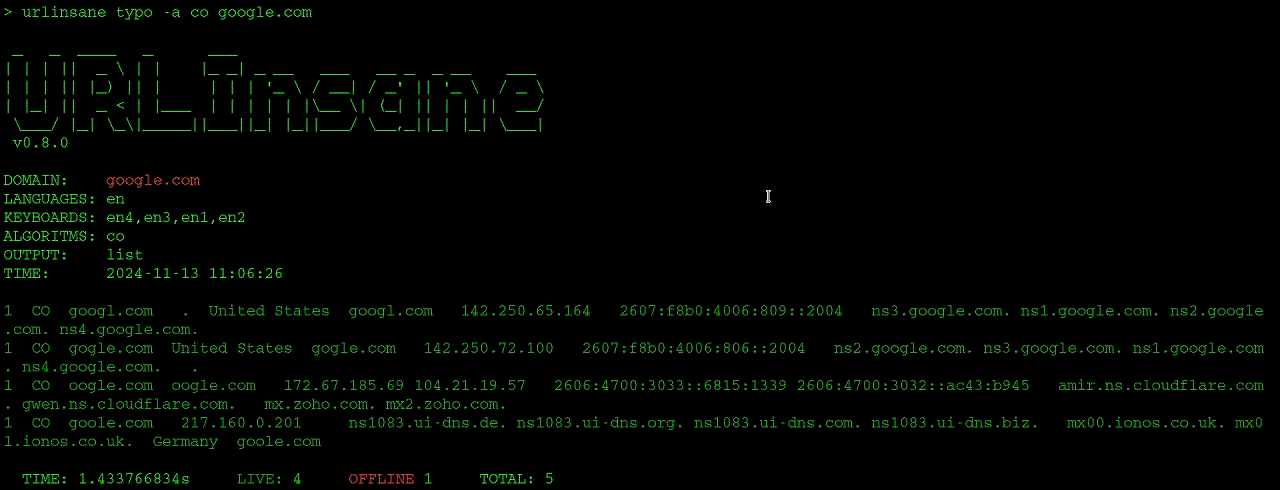
Release 0.8.2, from November 2024, is the pre-rewrite engine, with screenshot, banner, content ssdeep and redirect collectors. The rewritten graph engine on master needs a source build and adds WHOIS. No documentation of those web collectors on master was found. The CLI reference calls master mid-rewrite and lists flags that are specified but not built. 75–76,78–81,122–127
On master, 32 algorithms cover same-language and cross-language homophones, common misspellings, number words and 133 keyboard adjacency sets. Delegated-subdomain variants sit under free hosts such as duckdns.org and github.io, and a TLD swap runs across the public suffix list. Three-state existence (live, absent, unknown) keeps a failed lookup from reading as a free name, and clustering groups results on a shared address, nameserver or registrant, with Graphviz output. Master also generates email, package, username and repository-name variants, checks whether packages and usernames exist and flags dependency confusion. With the bundled endpoints, repository existence returns an undetermined result. 5,75–76,113–121,125,128–132
For CI, master exits with code 2 on --fail-on, writes deterministic output and NDJSON after the scan completes, marks partial results and replays saved scans. One target runs per invocation, and the automation guide shows cron and CI schedules. No public documentation of a built-in scheduler or alert delivery was found. The code is GPL-3.0, and a public book documents the engine. The last commit on master landed in August 2026, and the repository is not archived. Build it from the urlinsane repository, and read Have I Been Squatted vs urlinsane. 75–76,80,114–116,122–124,133–139
DNSRazzle#
Best for a team that wants screenshot comparison and multi-brand runs from a local script, and accepts active mail probes. 4–5,62,82–85,140
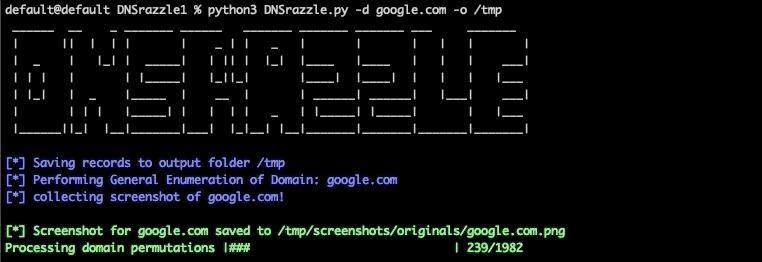
DNSRazzle builds on a pinned older dnstwist engine and adds a url-encoded-slash permutation for %2F link tricks. -d takes a comma list and -f a file, so one run covers many brands. Playwright captures viewport screenshots of each lookalike and scores them against the original site with SSIM. Optional nmap and dnsrecon runs probe the lookalikes that this path selects, and a blocklist file collects hosts behind visually similar pages. 4–5,61–62,82–85,140–143
The MX check connects to each lookalike's mail server and sends an SMTP test message, and no flag turns it off. Results stay on disk, and -e emails a CSV report through your own SMTP server. The final feature release shipped in April 2026, and the project now takes bug fixes only. The maintainer names SecurityShrimp Highlander, a separate commercial product, as its replacement. DNSRazzle is Apache-2.0 with no account or contractual scan quota, and talks at Kernelcon and Health-ISAC describe its use by Baxter's security team. Clone the DNSRazzle repository, and read Have I Been Squatted vs DNSRazzle. 60,62,82–83,85,140–141,144–150
openSquat#
Best for a researcher who wants a daily keyword match against new registrations, run locally. 86–93
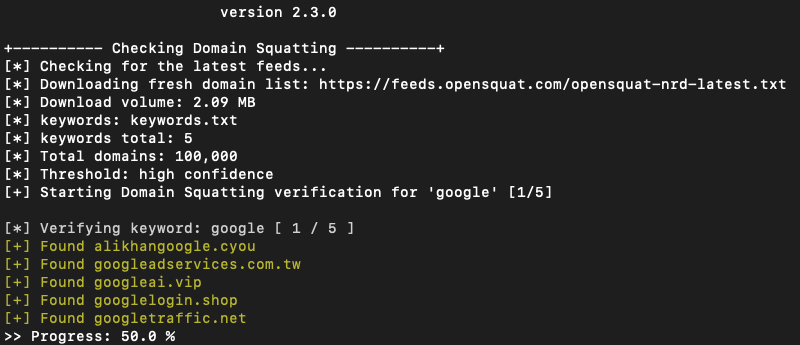
openSquat downloads a newly registered domain feed and matches brand keywords locally. The default daily feed lists about 100,000 domains, needs no account, and ships with a checksum file so unchanged downloads are skipped. Homograph handling transliterates non-Latin characters to Latin before comparing, so a Cyrillic lookalike can match. Optional flags add Quad9 reputation, VirusTotal votes, a phishing database, port checks and crt.sh, and output goes to TXT, JSON or CSV for cron jobs. 86–92,94,151–156
openSquat also sells hosted plans, from a free Community plan to USD 199 a month for Business. Every plan includes daily keyword alerts by email, an API and an MCP server, and openSquat adds Slack and Microsoft Teams alerts from Professional. A larger NRD Lite feed costs USD 39 a month. The API returns an IDN flag and the Unicode rendering for each homograph. The code is GPL-3.0. The default feed carries its own notice, which limits it to personal and research use and prohibits commercial use. The Community and Starter plans are also non-commercial, and the commercial license starts at Professional, at USD 49 a month. Maintenance is active, and the October 2026 release treats downloaded phishing lists as untrusted input. The repository had 989 stars and 163 forks in November 2026. Install it from the openSquat repository, and read Have I Been Squatted vs openSquat. 86–87,94,151,157–169
Free check in a browser#
These pages run one check with no install, and you repeat it by hand. The other two rows belong to tools profiled in other groups. 15,96,100,170–175
| Access | What it checks | What you get | |
|---|---|---|---|
| CIRCL Typosquatting finder | |||
| CIRCL Typosquatting finder | Misspellings, homophones, numeral swaps, dynamic-DNS suffixes177–181 | ||
| dnstwist.it | |||
| dnstwist.it | dnstwist permutations of one domain96 | Table of permutation, IP address, name server, mail server96 | |
| dnstwister search | |||
| dnstwister search | Found, available and error lists; CSV export186 | ||
Have I Been Squatted's Typosquat tool runs the same kind of one-off lookup after sign-in, so it is not a row above. 9,187–189
Typosquatting finder (CIRCL)#
Best for a one-off check in a browser, and for MISP users. 7–8,182,190–191
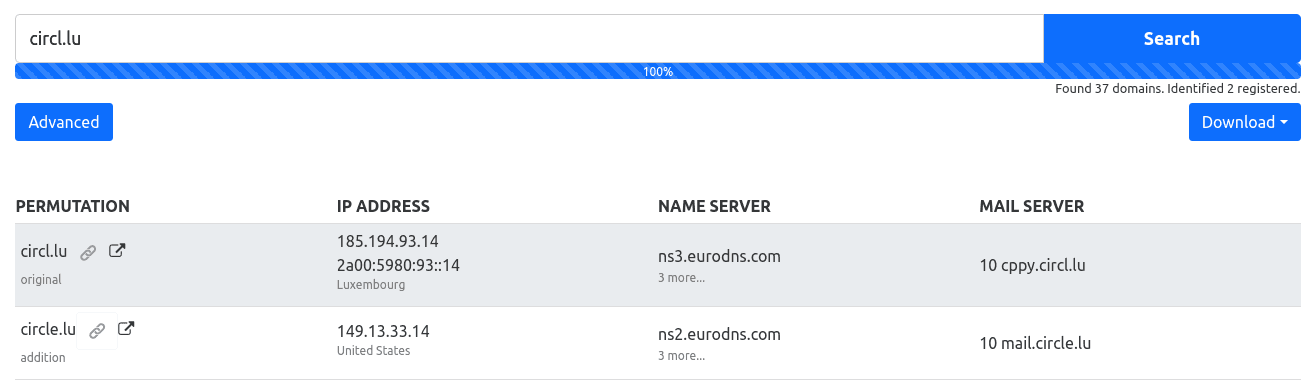
CIRCL runs a public browser check. Its permutation set covers common misspellings, homophones, numeral and plural forms and dynamic-DNS suffixes. A TLD swap runs across 1,441 bundled TLDs plus public-suffix second levels, with a wildcard DNS test for each variation. When that option is on, the website software compares a lookalike's page text and resources with the original and reports a combined ratio. Results download as JSON, a MISP feed or a MISP event, and the library emits YARA, regex and YAML for other tools. 7–8,171–172,176–183,190–194
CIRCL is the CERT for Luxembourg's private sector, communes and non-governmental entities, and the library acknowledges EU co-funding. The stack is open source end to end, with a BSD-2-Clause library and an Apache-2.0 website that you can self-host. PyPI statistics count 49,109 library downloads in one month, mirrors and CI included. The interface is one-shot, and no public documentation of recurring monitoring or alerts was found. In a November 2026 check, the hosted REST route returned a server error. Open the CIRCL Typosquatting finder, and read Have I Been Squatted vs CIRCL Typosquatting finder. 7–8,170–172,176,195–201
Self-serve hosted monitoring#
These services repeat checks and send alerts. You sign up, add a domain and review findings. Have I Been Squatted is listed first because this is its own site, and the other two follow in editorial order. 11–15,202
| Where candidates come from | Cadence | After a finding | |
|---|---|---|---|
| Have I Been Squatted | |||
| Have I Been Squatted | Stated at least once every 24 hours202 | ||
| CheckPhish | |||
| CheckPhish | Typosquat variants of one domain11 | Weekly variant scans11–14 | |
| dnstwister | |||
| dnstwister | About every 24 hours15 | ||
Have I Been Squatted#
Best for a security team that wants discovery beyond permutations, evidence it can inspect, and rules that block in its own tools or request a Takedown. 4–5,9–10,16–18,202
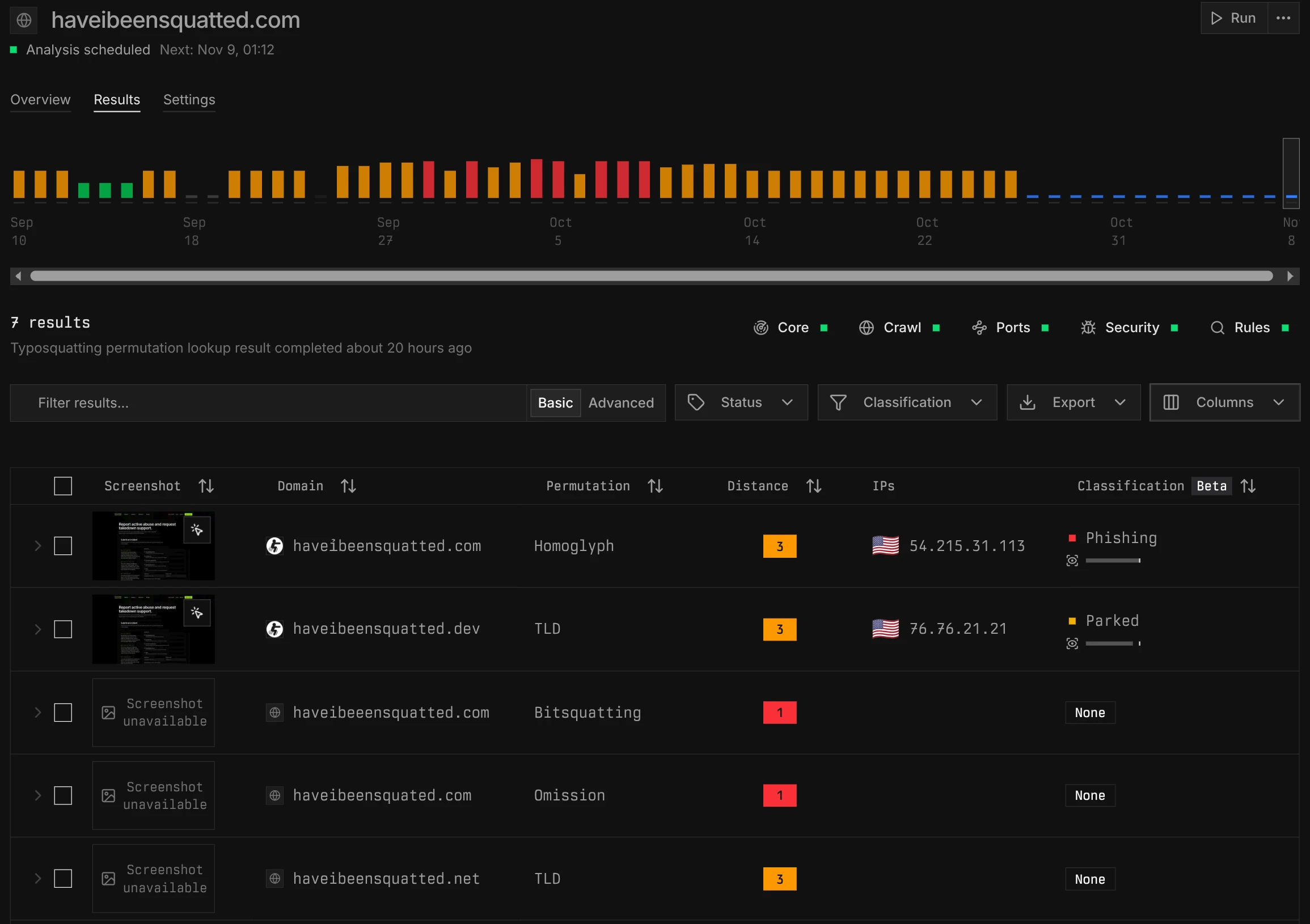
Have I Been Squatted starts from lookalikes and goes on to the malicious infrastructure behind them. Domain Monitoring combines permutations built on the open-source engine twistrs with certificate transparency and newly registered domains. The twistrs README states the goal of porting dnstwist, and lookups are stated to run at least once every 24 hours. The signal catalog lists 173 domain signals, and a result can include page semantics, favicon hashes, open ports, mail readiness and HAR data. An analyst can see whether a lookalike resolves, is set up for email or serves a copy of your page, then open it in an isolated browser. 4–5,9–10,188,202,208–210
Rules turn those signals into actions. A maintained library covers common detections, and your team can write its own rules. One rule can raise an alert, deliver the finding to a SIEM, push the domain to a block list, mark the result Malicious with a note or request a Takedown. Network rules stand alone and cannot block, annotate or request Takedowns. Managed Takedowns include analyst review, and the team reports each domain to its host and registrar, escalating where necessary. An MCP server and a Slack app let agents work the same queue, and every write needs an admin. 4–5,9,16–18,187,189,203–204,211–214
Beyond registered names, Discover lists unregistered permutations of your domain that could be used for phishing or brand impersonation. Pipelines can call the Public API, which streams lookup, analyze and certificate transparency search results as NDJSON, with scoped API keys and a Python SDK. Network Enforcement also publishes rule-flagged domains in a hosted domain feed with seven formats, among them CSV and STIX 2.1, and documents a MISP setup for it. Network Intelligence reads Microsoft Defender every 15 seconds and Cloudflare Gateway every minute, so you can see which domains devices on your network reached. Atlas investigations, in early access, start from a described hunt and any domains you already suspect, and pivot across shared infrastructure to related domains. 4,18,188–189,215–223
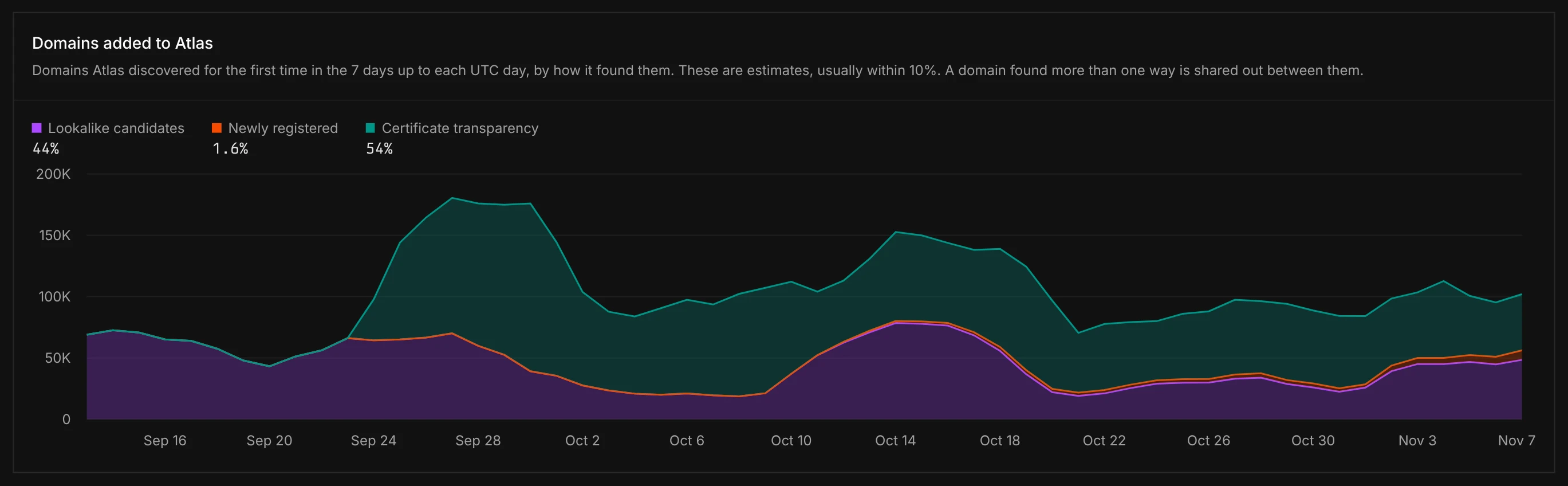
Domain Monitoring, hunting tools, rules and alerts are a public self-serve subscription, priced per monitored domain, with a 14-day trial. Takedowns and the email, network, SIEM and canary products are bought through sales. Have I Been Squatted does not monitor social media, app stores, ads or the dark web. Its Takedowns stop short of legal action, though the team can introduce third-party legal providers. See pricing. 9,202,219,224–225
CheckPhish#
Best for one brand domain that needs weekly typosquat checks with email alerts. 11–12,14,205,226
CheckPhish is Bolster's free tool. It monitors one brand domain, and more domains route to Bolster, which also runs the managed takedowns. Monitoring generates up to 300 typosquat variants of the domain and live-scans up to 100 of them each week, with email alerts. 11–12,14,205,226–227
The URL scanner returns a screenshot, the DOM and WHOIS, and CheckPhish advertises certificate and hosting details too. Verdicts use a broad scam taxonomy, with 12 disposition identifiers such as drug spam and streaming. Scans can use a preset or custom user agent, and an API key with a documented quota supports scripts. Listed integrations include a Microsoft Security Copilot plugin, an Outlook add-in, a community Splunk SOAR connector and Tines templates. Open the CheckPhish homepage. 12,14,226,228–234
dnstwister#
Best for daily email alerts on a few domains. 15,235
dnstwister's hosted service checks lookalikes of each monitored domain about every 24 hours and resolves A and MX records for each one. Alerts arrive by email and RSS, with a separate list for new MX records. IP and CIDR mutes cut repeat noise, a newly_monitored flag separates algorithm changes from fresh registrations for seven days, and each alert email carries a management link. For removal, dnstwister publishes a takedown guidance template. No public documentation of a takedown service was found. 15,186,206,235–238
Monitoring is a public self-serve subscription for one domain or a multi-domain estate, with a four-week trial that needs no card. More than 100 domains needs a contact. The open-source web app, under the Unlicense, wraps a modified copy of dnstwist, while the hosted service code is private. On November 4 and 8, 2026, the status page listed open issues with DNS resolution and delta calculations, and the public /api/ip/ endpoint returned errors for well-known domains, so check the status page before you rely on it. Try dnstwister.report, and read Have I Been Squatted vs dnstwister. 63–65,235,239–241
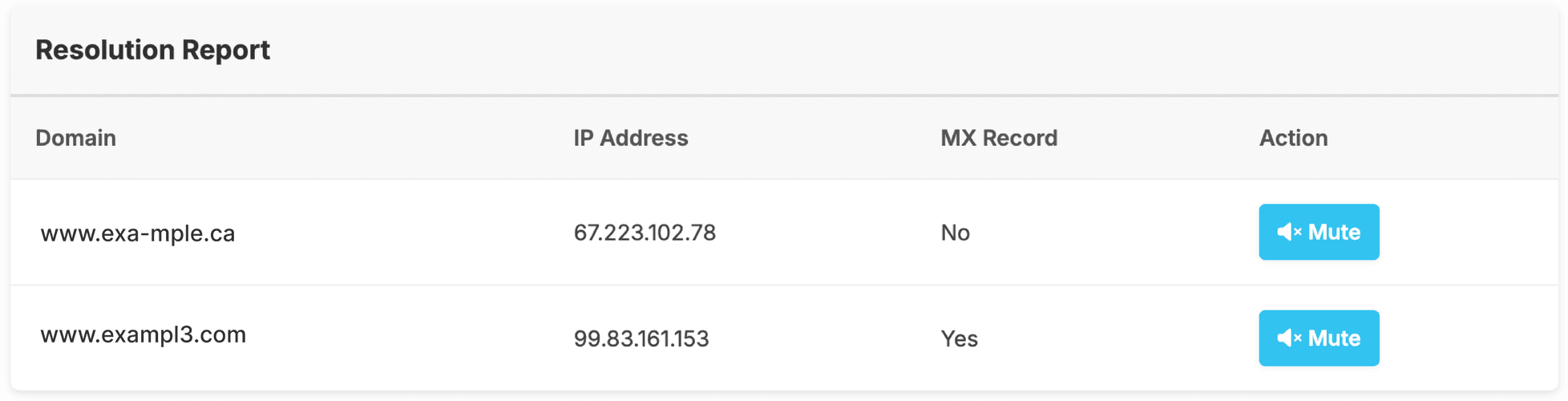
Domain protection
Detect adversary infrastructure while it is being staged.
Have I Been Squatted helps security teams detect lookalike domains, certificate and DNS changes, and staging infrastructure, investigate the evidence, and coordinate takedowns.
Managed detection and takedown#
These vendors detect lookalike domains and run takedowns, usually across channels beyond domains. Order is alphabetical, and the split between these profiles and the shorter table further down is editorial. 27,44,242–248
| Takedown model | Response beyond removal | Channels beyond domains | |
|---|---|---|---|
| Bolster | |||
| Bolster | Bolster starts it for phish and scam findings, automatically or by a SOC analyst19–25 | Playbook adds domains to the Exchange and Defender block list249 | Social, app stores, marketplaces, ads, deepfakes, dark web31–35 |
| Netcraft | |||
| Netcraft | Automated takedown, escalation to managed26 | Browser and antivirus feed blocking while a takedown runs250–251 | Social, ads, apps, dark web, phone numbers, scam conversations36–40 |
| Red Points | |||
| Red Points | Fully managed by IP-Ops specialists27–28 | Social, ads, app stores, marketplaces, search deindexing46–51 | |
| ZeroFox | |||
| ZeroFox | ZeroFox analysts handle every takedown29–30 | ||
Bolster#
Best for a brand, fraud or security team that wants automatic takedowns across web, social, app stores and marketplaces. 19–21,23,31–35
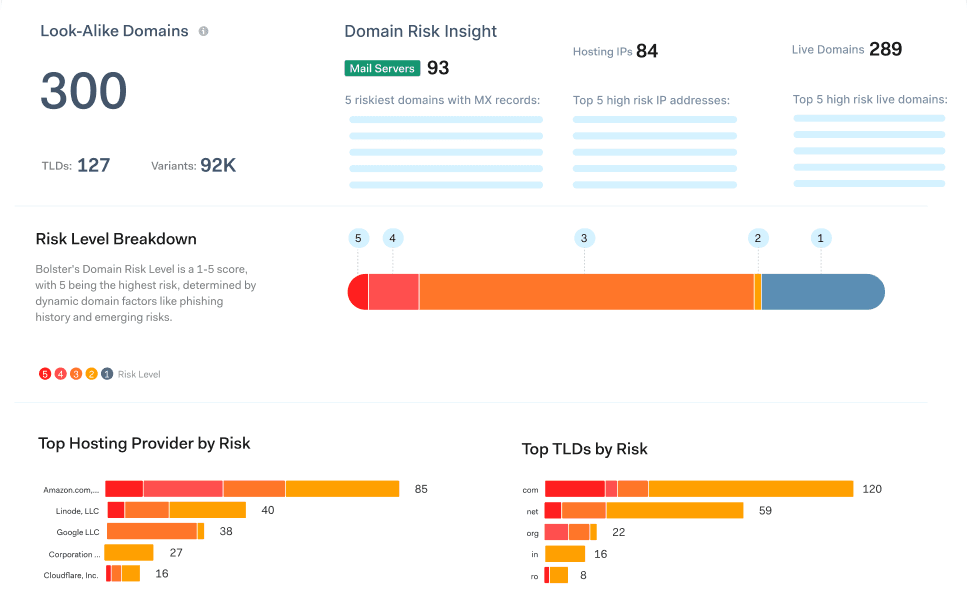
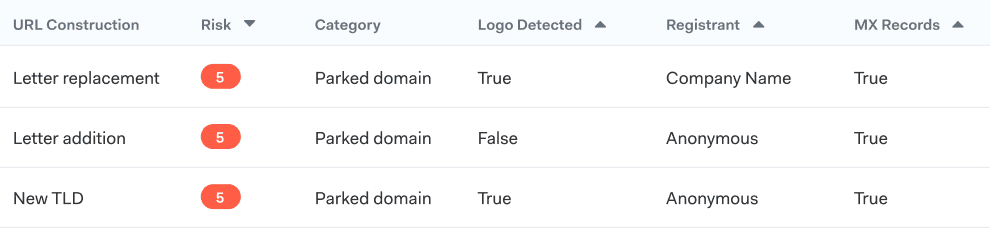
Bolster detects lookalikes and starts the takedown itself for a newly scanned URL judged phish or scam, either automatically or through a SOC analyst. Coverage reaches social media, app stores, marketplaces, paid ads, deepfakes and the dark web. A documented permutation set of 13 types includes homoglyphs and bitsquatting. 19–25,31–35,256
Threat Graph links one finding to related infrastructure so takedowns can be coordinated. A playbook adds Bolster-identified domains to the Microsoft Exchange and Defender block list, and playbook connectors cover Slack, Teams, Splunk, Sentinel and XSOAR. The Scan API returns logo detection output, and the customer license sets its quota and rate. Bolster says it is partnering with Akamai on capture from multiple vantage points and calls that work still in progress. Bolster is bought through a quote-based contract, and it owns CheckPhish. Contact Bolster, and read Have I Been Squatted vs Bolster. 23,31,42,242,244,249,257–270
Netcraft#
Best for an organization that wants managed takedown at scale, with blocking while it runs. 250–251,271
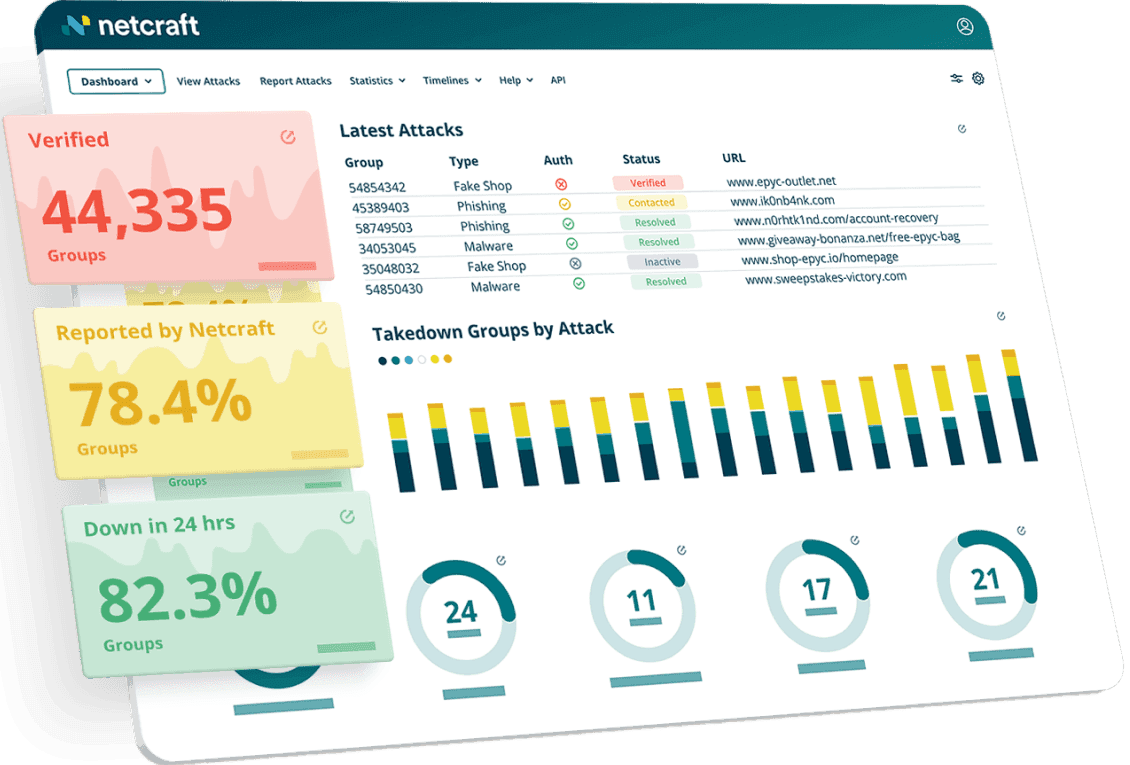
Netcraft combines managed takedowns with feeds that browsers and antivirus vendors use to block threats while removal proceeds. A customer reports or authorizes an attack, can set auto-authorization by attack type, and can escalate an automated takedown to a managed one. Netcraft states that most removals go through direct API or provider contacts, and that it takes down about one-third of global phishing attacks. Preemptive Domain Disruption targets domains before content goes live. 26,250–251,271–273
Anti-cloaking capture uses a proxy network, a headless browser and multi-stage form filling. Takedowns run from the SOC through documented XSOAR commands and a bi-directional Splunk app. Coverage reaches social media, ads, apps, the dark web, phone numbers and scam conversations. Netcraft states that its SOC 2 Type 2 report has no exceptions, and Forrester evaluated it in its External Threat Intelligence Service Providers Wave for Q3 2026. Netcraft is bought through a quote-based contract. Use the Netcraft contact form, and read Have I Been Squatted vs Netcraft. 26,36–41,274–279
Red Points#
Best for a consumer or retail brand with registered trademarks that wants a vendor to run enforcement across many channels, including UDRP recovery of domains. 46–51,252–253,280
Red Points runs domain work inside a wider brand protection platform. Domain Management detects, monitors and reclaims domains that misuse a brand, and Impersonation Removal handles fake sites, beside modules for counterfeits, social media, ads and apps. Red Points also markets coverage of deepfakes and Mainland China. IP-Ops specialists run detection, validation and enforcement, and they handle pushbacks and counter-notices. A dedicated Customer Success Manager supports each customer. Red Points compares logos, page images, objects and extracted text against brand assets, including for domains that do not contain the brand name. 27–28,46–51,246,252,280
Red Points recovers domains through UDRP, URS and national dispute proceedings. It claims to suspend fraudulent domains before content is published, through registrar and host partnerships. Programs are bought through a quote-based contract at a flat fee, with unlimited detections and takedowns within the agreed scope, and GoDaddy customers have a separate fake-website protection offer. Red Points reports 300 or more employees, 1,300 or more brands, a SaaS model since 2014, and offices in the US, Spain and China. 46,252–253,280–284
Enforcement needs trademark or patent certificates for each protected territory, a Letter of Authorization and a business license. After activation, the customer validates incidents in the portal, and Red Points says that validation can also be automated. Request a Red Points quote, and read Have I Been Squatted vs Red Points. 28,46,285
ZeroFox#
Best for an organization that wants analyst-validated alerts and managed takedowns across social, apps and domains under one contract. 29–30,286
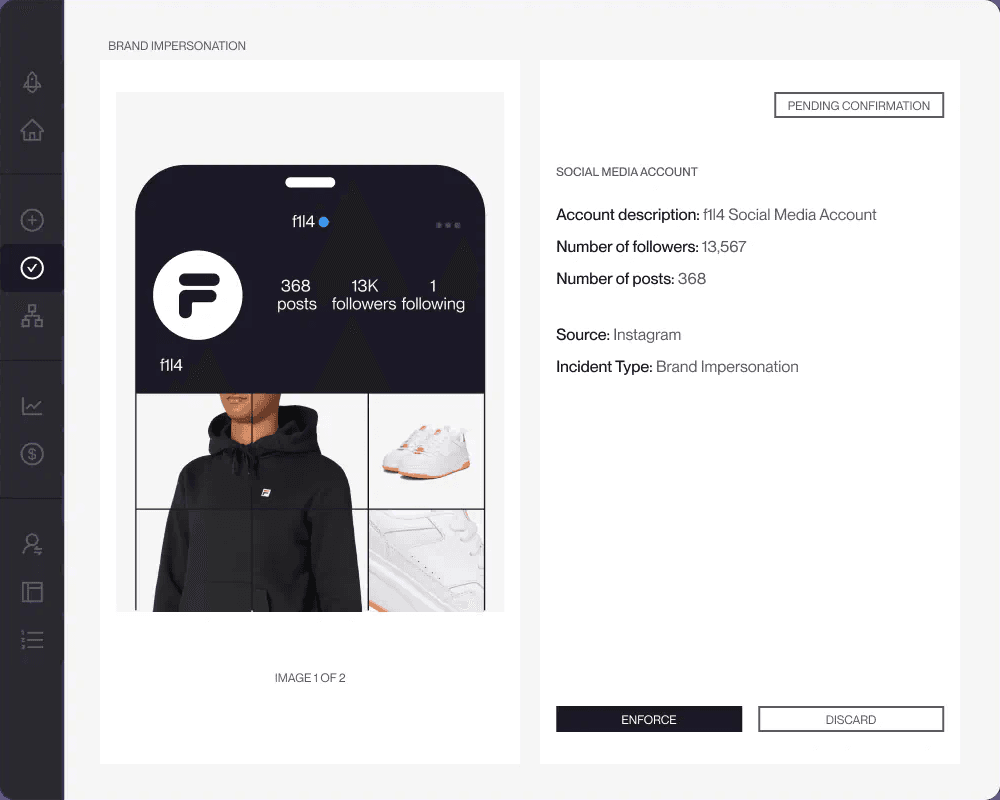
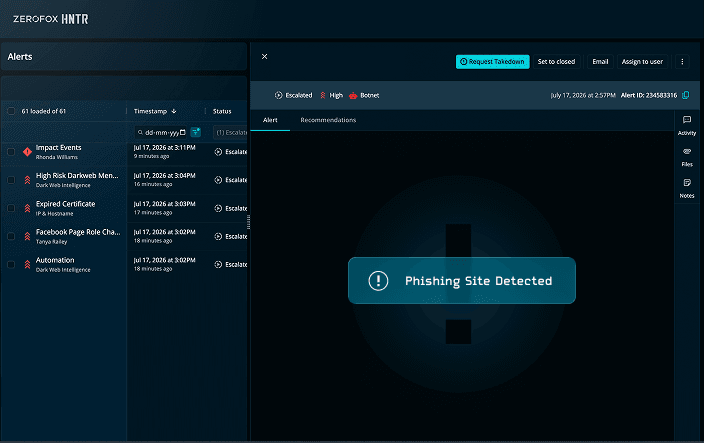
ZeroFox analysts handle every takedown and remediation, and customers request work in the platform or through the API. A takedown counts against the contract only when it completes. Targets reach past domains to social profiles, apps, marketplace listings, personal data on data brokers and UDRP filings. While a takedown runs, partner blocking includes Google Web Risk priority review. 29–30,254–255
A 24x7 managed service validates critical and high alerts before they reach you. Anti-cloaking analysis gets past geofencing, device fingerprinting, CAPTCHAs and delayed rendering. The integration library names more than 40 SIEM, SOAR, TIP, ITSM, BI and chat connectors, plus webhooks and STIX/TAXII, and ZeroFox reports Forrester recognition for brand threat intelligence and takedown services. Direct purchase is a quote-based contract, and UK public-sector buyers can also buy through G-Cloud resellers. Each contract sets a yearly takedown allowance and a number of protected domains. Review ZeroFox Domain Protection, and read Have I Been Squatted vs ZeroFox. 29,248,278,286–290
More managed services#
Nine more managed vendors describe lookalike domain detection. Axur offers one-click and Zero-Touch Takedowns, BrandShield offers managed, self-service and hybrid models, and PhishFort also takes single takedowns of incidents you already found. SOCRadar offers a free account with no expiry date. 291–323
| Takedowns | Distinct strength | How you buy | |
|---|---|---|---|
| Axur | |||
| Axur | One-click or Zero-Touch Takedowns312–317 | OnePixel cloned-site detection script324 | Contract with an annual takedown package325–326 |
| BrandShield | |||
| BrandShield | Managed, self-service and hybrid models318–320 | 12-month AWS Marketplace contract with takedowns295 | |
| CloudSEK XVigil | |||
| CloudSEK XVigil | Re-scans past fake domains on WHOIS, SSL or re-registration changes334 | 12-month contracts on AWS Marketplace335 | |
| Doppel | |||
| Doppel | Internal SOC executes every takedown336–338 | Threat Graph links domains, profiles, ads and phone numbers339–340 | Quote-based contract341 |
| Fortra Brand Protection | |||
| Fortra Brand Protection | Quote-based contract343–345 | ||
| Group-IB | |||
| Group-IB | |||
| PhishFort | |||
| PhishFort | Quote-based managed service321 | ||
| Recorded Future | |||
| Recorded Future | Logo hash, screenshot OCR and login-form checks on lookalike pages309 | Quote-based contract354–355 | |
| SOCRadar | |||
| SOCRadar | Quote-based contract310 | ||
- Have I Been Squatted vs Axur
- Have I Been Squatted vs BrandShield
- Have I Been Squatted vs CloudSEK
- Have I Been Squatted vs Doppel
- Have I Been Squatted vs Fortra
- Have I Been Squatted vs Group-IB
- Have I Been Squatted vs PhishFort
- Have I Been Squatted vs Recorded Future
- Have I Been Squatted vs SOCRadar
Investigation platform with lookalike monitors#
These platforms treat lookalike discovery as one module inside a wider investigation or threat-intelligence workflow. 55–58
| DomainTools Iris Detect | Silent Push | |
|---|---|---|
| What you watch | ||
| What you watch | A target domain or an assets folder of domains or IPs358–360 | |
| Cadence | ||
| Cadence | ||
| Alerts | ||
| Alerts | ||
| Next step | ||
| Next step | Pivot on favicon, ssdeep, JARM and banners to related infrastructure371–373 | |
DomainTools Iris Detect#
Best for an investigation or SOC team that already works in DomainTools data. 55–57,374–377
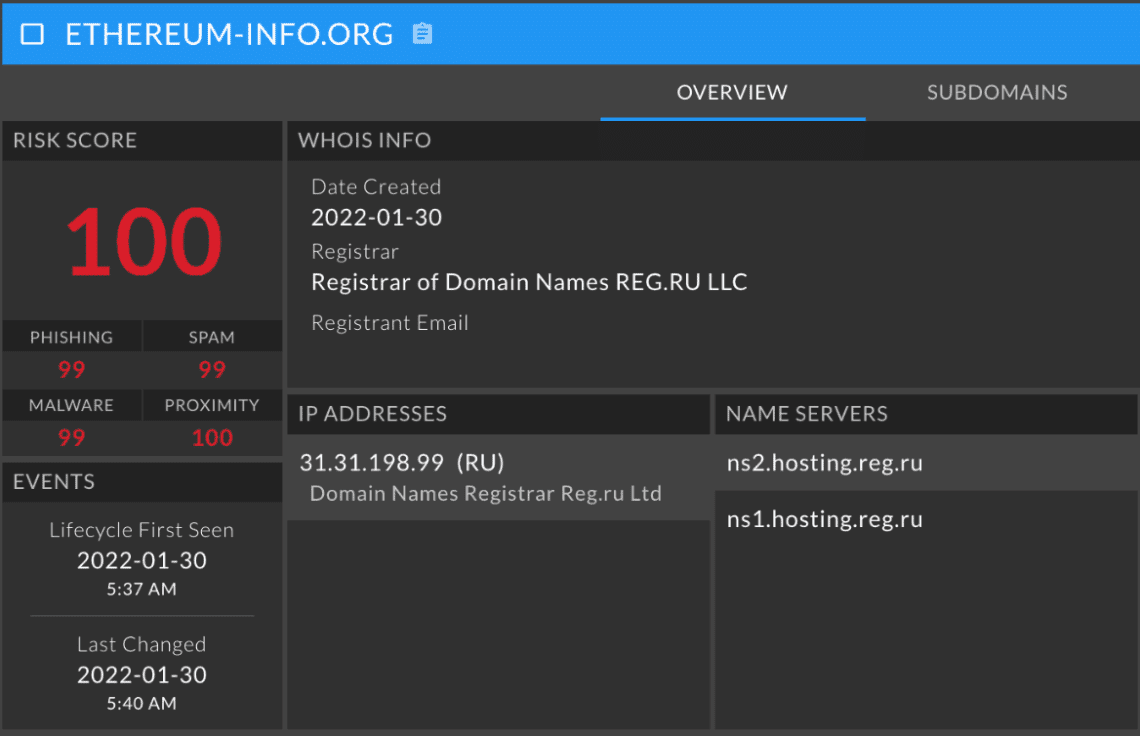
Iris Detect monitors a keyword term for lookalike domains, using 15 named variation algorithms with IDN and fuzzy matching. A provisional proximity and phishing score arrives within minutes, and the full score follows in 15 to 25 minutes. WHOIS history, hosting history, more than a decade of passive DNS from Farsight DNSDB and screenshot history sit behind each result. The Iris Pivot Engine adds guided and historical pivots, IrisQL, collaboration and reports. 56–57,357,365,374–381
Domain and IP risk feeds, hotlists and RPZ delivery support blocking at scale, and more than 25 named SIEM, SOAR, TIP and XDR integrations carry results into the SOC. A hosted MCP server exposes Iris Investigate, DNSDB and Domain History to agents. No public documentation of a managed takedown service was found. Iris Detect needs a DomainTools account under a quote-based contract. Review DomainTools Iris Detect, and read Have I Been Squatted vs DomainTools. 55–57,361,366,370,381–388
Silent Push#
Best for a threat intelligence team that treats lookalikes as one input to infrastructure hunting. 58,369,389–390
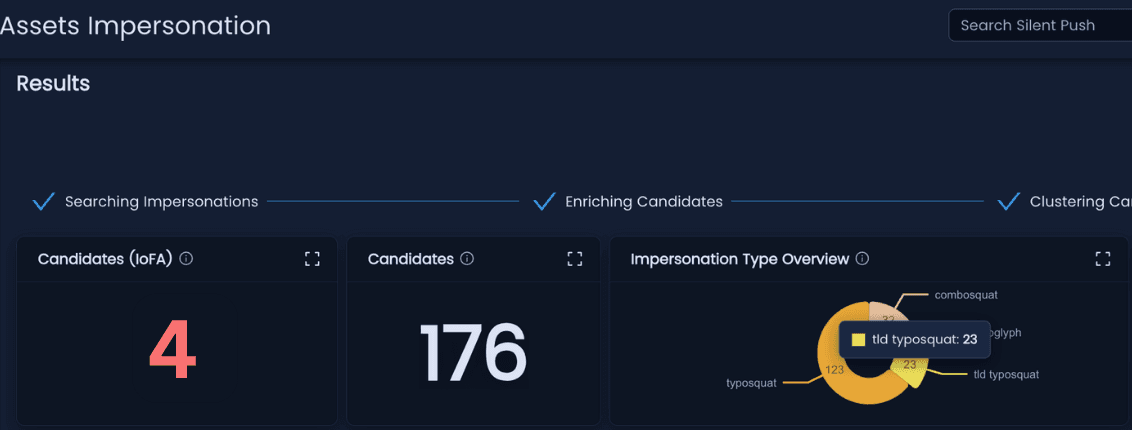
Silent Push Domain Impersonation takes a target domain, and Assets Impersonation searches a folder of domains or IPs. From one lookalike, an analyst can pivot on favicon hashes, ssdeep, JARM and banners, and read passive DNS and WHOIS history, to find the infrastructure around it. First-party scan data spans six data sources, searchable with SPQL, and Traffic Origin adds proxy and VPN origin data. 358–360,371–373,391–396
IOFA feeds, APT feeds, TLP Amber reports and analyst services extend the work to threat actors, and Silent Push states that IOFA often reveal attacks three to six months in advance. It lists 20 named SIEM, SOAR and TIP integrations, plus TAXII. Silent Push is bought through a demo and a quote, and also offers a free account. Review Silent Push, and read Have I Been Squatted vs Silent Push. 369,389–390,397–405
Certificate feeds and search datasets#
Certificate transparency sources supply new names, and you supply the brand terms and the matching. crt.sh is a free certificate search with no sign-up and guest SQL access to the whole database. In November 2026 checks, some guest SQL connection attempts were refused, and its database and web search lagged the CT logs by more than two weeks. CertStream defines a simple MIT-licensed websocket JSON format that pushes each new certificate to clients, and an active Go server fork supports self-hosting. Its public demo server sent no entries in a November 2026 test, so plan to run your own. No public documentation of lookalike generation was found for either. Phishing Catcher, a GPL-3.0 CertStream consumer, scores every name in the stream with editable YAML keyword weights and checks for confusable characters and one-edit typos. It reads the public CertStream server unless you edit the code, and its last commit on master dates from December 2020. 406–442
Censys, urlscan.io and VirusTotal search their own datasets for lookalikes and can watch a query over time. Censys's CenQL twist function finds typosquats, and collections send webhooks and email digests. urlscan.io searches Newly Observed Domains with exact, fuzzy and regex queries, and subscriptions send new matches by email or webhook. VirusTotal Livehunt rules use permutation_of, and Digital Threat Monitoring in Google Threat Intelligence also watches domain registrations. Each also serves wider investigation. Censys scans every IPv4 port, urlscan.io keeps a historical scan corpus with visual search, and VirusTotal adds multi-engine reputation and free relationship data. 443–465
Choose by need#
Two questions settle most choices. Who reviews the findings, and who handles the response? If your team reviews and responds with its own scripts, a local scanner or a browser check is enough. If your team reviews but wants the tool to repeat checks and trigger alerts, blocks or takedown requests, choose hosted monitoring. If you want a vendor to review findings and remove abuse across social media, app stores and marketplaces, choose a managed service. If your analysts already hunt in DomainTools or Silent Push data, add their lookalike monitors. 6,16–18,29,31–35,55–58,286
Is Have I Been Squatted right for you?#
Choose Have I Been Squatted when your security team wants lookalike discovery it does not have to run, a path from each lookalike to the infrastructure behind it, and a response it controls. Domain Monitoring watches permutations, certificate transparency and newly registered domains continuously. Each result shows whether the lookalike resolves or is set up for email, and an analyst can open a live page in an isolated browser session. Rules then alert, block the domain in your gateways and endpoints or request a Takedown, and you can start self-serve with a free trial. For a one-off check, use its Typosquat tool or a local scanner. For the channels and the legal action outside the scope in its profile, choose a managed vendor. 5,9–10,16–18,187–189,202,210,217–218,224–225,466–467
FAQ#
No. Registration alone does not establish abuse, so investigate the domain before you treat it as malicious. CIRCL warns that results can include legitimate domains with similar names. 7
Check the evidence first. Does the domain resolve, have MX records or serve a copy of your page, and who registered it? Blocking protects users while a takedown runs. Netcraft and ZeroFox block through partner feeds, and Have I Been Squatted can send the domain to your own gateways and DNS filters. The takedown request then goes to the host and registrar, and dispute processes such as UDRP recover a domain you want back. 5,9,30,46,202,211–213,217–218,250–255,466–467
Sources and corrections
Each numbered marker on this page links to its sources below. Each source shows the date it was last checked. If a fact is wrong or out of date, send a correction. A correction is checked against the source and the page is updated.
- 1.GitHub. “GitHub repository metadata.” Accessed . https://api.github.com/repos/elceef/dnstwist
- 2.elceef. “LICENSE.” Accessed . https://github.com/elceef/dnstwist/blob/341395377f40761fe4152f43fd18eea757b6069a/LICENSE
- 3.elceef (Marcin Ulikowski). “dnstwist README.” Accessed . https://github.com/elceef/dnstwist/blob/341395377f40761fe4152f43fd18eea757b6069a/docs/README.md
- 4.Have I Been Squatted. “Changelog.” Accessed . https://haveibeensquatted.com/changelog
- 5.Have I Been Squatted. “Domain signals.” Accessed . https://docs.haveibeensquatted.com/reference/signals/domain/
- 6.elceef. “dnstwist.py (`Fuzzer`, `Scanner`, `Whois`, `pHash`, `Format`).” Accessed . https://github.com/elceef/dnstwist/blob/341395377f40761fe4152f43fd18eea757b6069a/dnstwist.py#L832
- 7.CIRCL. “About.” Accessed . https://typosquatting-finder.circl.lu/about
- 8.CIRCL. “Typosquatting-finder.” Accessed . https://typosquatting-finder.circl.lu/
- 9.Have I Been Squatted. “Pricing.” Accessed . https://haveibeensquatted.com/pricing
- 10.Have I Been Squatted. “Domain monitoring guide.” Accessed . https://docs.haveibeensquatted.com/features/domain-monitoring/
- 11.Bolster. “Using CheckPhish Domain Monitoring (WB 2025-10-06).” Accessed . https://web.archive.org/web/20251006145251/https://bolster.ai/kbarticles/using-checkphish-domain-monitoring
- 12.Bolster. “CheckPhish homepage (WB 2026-10-16).” Accessed . https://web.archive.org/web/20261016082655/https://checkphish.bolster.ai/
- 13.Bolster. “Developer-Friendly CheckPhish API (WB 2026-10-06).” Accessed . https://web.archive.org/web/20261006140143/https://checkphish.bolster.ai/checkphish-api/
- 14.Bolster. “CheckPhish Plans & Packages, compare table (WB 2025-01-24).” Accessed . https://web.archive.org/web/20250124174213/https://checkphish.bolster.ai/plans/
- 15.dnstwister. “Documentation, APIs (subscriber).” Accessed . https://dnstwister.report/documentation/dnstwister_apis
- 16.Have I Been Squatted. “Rules engine guide.” Accessed . https://docs.haveibeensquatted.com/guides/rules-engine/
- 17.Have I Been Squatted. “Integrations.” Accessed . https://haveibeensquatted.com/platform/integrations
- 18.Have I Been Squatted. “Network Intelligence guide.” Accessed . https://docs.haveibeensquatted.com/features/network-intelligence/
- 19.Bolster. “KB: Web Dashboard.” Accessed . https://web.archive.org/web/20251006142814/https://bolster.ai/kbarticles/using-the-bolster-dashboard
- 20.Bolster. “KB: Legacy Web Dashboard.” Accessed . https://bolster.ai/kbarticles/using-the-bolster-dashboard
- 21.Bolster. “KB: Submitting Takedown Requests in Bolster.” Accessed . https://bolster.ai/kbarticles/submitting-takedown-requests-in-bolster
- 22.Bolster. “Automated Takedown.” Accessed . https://web.archive.org/web/20260320103943/https://bolster.ai/platform/automated-takedown
- 23.Bolster. “Automated takedown service and threat remediation, "Accelerated DMCA Takedown Response" section.” Accessed . https://bolster.ai/platform/automated-takedown
- 24.Bolster. “Customer Abuse Mailbox.” Accessed . https://web.archive.org/web/20260320103943/https://bolster.ai/platform/customer-abuse-mailbox
- 25.Bolster. “Bolster homepage.” Accessed . https://web.archive.org/web/20260407072545/https://bolster.ai/
- 26.Palo Alto Networks. “Netcraft V2 integration.” Accessed . https://xsoar.pan.dev/docs/reference/integrations/netcraft-v2
- 27.Red Points. “Domain & Website Takedown Service.” Accessed . https://www.redpoints.com/usecase/domain-takedown/
- 28.Red Points. “Onboarding Docs: Details (IP rights).” Accessed . https://www.redpoints.com/onboarding-details/
- 29.ZeroFox. “Pricing.” Accessed . https://www.zerofox.com/pricing/
- 30.ZeroFox. “Disrupt.” Accessed . https://www.zerofox.com/platform/disrupt/
- 31.Bolster. “Site navigation and footer.” Accessed . https://web.archive.org/web/20261026161431/https://bolster.ai/author/lauren-barraco
- 32.Bolster. “Fake App Monitoring and Takedowns.” Accessed . https://web.archive.org/web/20260320104002/https://bolster.ai/platform/fake-apps-monitoring
- 33.Bolster. “Dark Web AI Monitoring.” Accessed . https://web.archive.org/web/20260320103958/https://bolster.ai/platform/dark-web-monitoring
- 34.Bolster. “Marketplace Fraud Is Costing Brands More Than They Realize (2026-05-01).” Accessed . https://web.archive.org/web/20260511125513/https://bolster.ai/blog/marketplace-monitoring-and-takedowns
- 35.Bolster via PR Newswire (syndicated by CIO Influence). “Bolster AI Expands External Threat Protection with Fraudulent Ads Monitoring (2026-07-21).” Accessed . https://cioinfluence.com/security/bolster-ai-expands-external-threat-protection-with-fraudulent-ads-monitoring/
- 36.Netcraft. “Social Media Brand Protection.” Accessed . https://www.netcraft.com/platform/threat-detection-and-takedown/social-media-protection
- 37.Netcraft. “Mobile App Protection.” Accessed . https://www.netcraft.com/platform/threat-detection-and-takedown/mobile-app-protection
- 38.Netcraft. “Deep and Dark Web Monitoring.” Accessed . https://www.netcraft.com/platform/threat-detection-and-takedown/deep-and-dark-web-monitoring
- 39.Netcraft. “Phone Scam Disruption.” Accessed . https://www.netcraft.com/platform/threat-detection-and-takedown/phone-scam-disruption
- 40.Netcraft. “Netcraft Scam Intelligence.” Accessed . https://www.netcraft.com/platform/threat-intelligence/netcraft-scam-intelligence-text-based-scams
- 41.Netcraft. “Platform Overview.” Accessed . https://www.netcraft.com/platform
- 42.Bolster. “Bolster Integrations.” Accessed . https://web.archive.org/web/20260320103958/https://bolster.ai/partner/integrations
- 43.Bolster. “Fraudulent ads monitoring and scam ad takedowns.” Accessed . https://bolster.ai/platform/fraudulent-ads-monitoring
- 44.Bolster. “KB: Intro to Assets.” Accessed . https://web.archive.org/web/20251006134427/https://bolster.ai/kbarticles/intro-to-assets
- 45.Bolster. “KB: Intro to Assets.” Accessed . https://bolster.ai/kbarticles/intro-to-assets
- 46.Red Points. “Pricing & Plans (Brand Impersonation).” Accessed . https://www.redpoints.com/pricing/
- 47.Red Points. “AI Brand Protection Platform.” Accessed . https://www.redpoints.com/
- 48.Red Points. “Marketplace Brand Protection.” Accessed . https://www.redpoints.com/software/marketplaces/
- 49.Red Points. “Fake Ad Detection & Removal.” Accessed . https://www.redpoints.com/software/ad-protection/
- 50.Red Points. “Mobile App Brand Protection.” Accessed . https://www.redpoints.com/software/mobile-apps/
- 51.Red Points. “Search Engine Content Removal.” Accessed . https://www.redpoints.com/software/search-engine-removal-services/
- 52.ZeroFox. “ZeroFox Digital Risk Protection.” Accessed . https://www.zerofox.com/solutions/protection/
- 53.ZeroFox. “Social Media Protection.” Accessed . https://www.zerofox.com/solutions/protection/social-media-protection/
- 54.ZeroFox. “Intelligence Collection.” Accessed . https://www.zerofox.com/platform/intelligence-collection/
- 55.DomainTools. “Iris platform.” Accessed . https://docs.domaintools.com/iris/
- 56.DomainTools. “Iris Detect user guide.” Accessed . https://docs.domaintools.com/iris/detect/
- 57.DomainTools. “DomainTools Debuts New Domain Discovery Solution, Iris Detect (2022-02-10).” Accessed . https://www.domaintools.com/press/domaintools-debuts-new-domain-discovery-solution-iris-detect
- 58.Silent Push. “Impersonation.” Accessed . https://help.silentpush.com/docs/impersonation
- 59.Have I Been Squatted. “Administration guide.” Accessed . https://docs.haveibeensquatted.com/guides/administration/
- 60.SecurityShrimp (`f8al`). “dnsrazzle/MailUtil.py (also `etc/mail_config.conf.sample`).” Accessed . https://github.com/f8al/DNSrazzle/blob/1cf41837574610d42418fd078c51903b52fb850b/dnsrazzle/MailUtil.py#L145
- 61.SecurityShrimp (`f8al`). “requirements.txt.” Accessed . https://github.com/f8al/DNSrazzle/blob/1cf41837574610d42418fd078c51903b52fb850b/requirements.txt
- 62.elceef (Marcin Ulikowski). “dnstwist.py at tag 20201228 (`DomainFuzz`, `DomainThread`).” Accessed . https://github.com/elceef/dnstwist/blob/20201228/dnstwist.py#L506
- 63.Robert Wallhead. “dnstwister README.” Accessed . https://github.com/dnstwister/dnstwister/blob/ebf4ea72fee43d411bcc8d2e8a9b9bb375c49115/README.md
- 64.Robert Wallhead. “UNLICENCE.” Accessed . https://github.com/dnstwister/dnstwister/blob/ebf4ea72fee43d411bcc8d2e8a9b9bb375c49115/UNLICENCE
- 65.Marcin Ulikowski, modified by Robert Wallhead. “Embedded dnstwist module.” Accessed . https://github.com/dnstwister/dnstwister/blob/ebf4ea72fee43d411bcc8d2e8a9b9bb375c49115/dnstwister/dnstwist/__init__.py
- 66.elceef. “dnstwist.py (`--registered` option).” Accessed . https://github.com/elceef/dnstwist/blob/341395377f40761fe4152f43fd18eea757b6069a/dnstwist.py#L1272
- 67.elceef. “dnstwist man page.” Accessed . https://github.com/elceef/dnstwist/blob/341395377f40761fe4152f43fd18eea757b6069a/docs/dnstwist.1
- 68.Andrew Horton (urbanadventurer). “URLCrazy README.” Accessed . https://github.com/urbanadventurer/urlcrazy/blob/78bf6e855d6d83e387ae3b5c8ffc36f241b96f66/README.md
- 69.Andrew Horton. “lib/domainname.rb (typo generators).” Accessed . https://github.com/urbanadventurer/urlcrazy/blob/78bf6e855d6d83e387ae3b5c8ffc36f241b96f66/lib/domainname.rb
- 70.Andrew Horton. “urlcrazy (main script, options, license header).” Accessed . https://github.com/urbanadventurer/urlcrazy/blob/78bf6e855d6d83e387ae3b5c8ffc36f241b96f66/urlcrazy
- 71.Andrew Horton. “lib/typo.rb (DNS and popularity).” Accessed . https://github.com/urbanadventurer/urlcrazy/blob/78bf6e855d6d83e387ae3b5c8ffc36f241b96f66/lib/typo.rb
- 72.GitHub. “GitHub repository metadata.” Accessed . https://api.github.com/repos/urbanadventurer/urlcrazy
- 73.Kali Linux. “Kali package debian/copyright.” Accessed . https://gitlab.com/kalilinux/packages/urlcrazy/-/raw/kali/master/debian/copyright
- 74.Repology. “urlcrazy package versions.” Accessed . https://repology.org/project/urlcrazy/versions
- 75.Rangertaha. “URLInsane README (lines 9, 45 to 46, 99 to 116, 164 to 205, 269 to 305).” Accessed . https://github.com/rangertaha/urlinsane/blob/4f53d2e839f79520dc520976f1b634fdb3566406/README.md
- 76.Rangertaha. “CLI reference (§1 to §9).” Accessed . https://github.com/rangertaha/urlinsane/blob/4f53d2e839f79520dc520976f1b634fdb3566406/docs/CLI.md
- 77.Rangertaha. “Limits and termination.” Accessed . https://github.com/rangertaha/urlinsane/blob/4f53d2e839f79520dc520976f1b634fdb3566406/docs/internals/limits.md
- 78.Rangertaha. “README at release `0.8.2` (lines 155 to 183).” Accessed . https://github.com/rangertaha/urlinsane/blob/0.8.2/README.md
- 79.Rangertaha. “`observe/all/all.go` (`New`).” Accessed . https://github.com/rangertaha/urlinsane/blob/4f53d2e839f79520dc520976f1b634fdb3566406/internal/plugins/observe/all/all.go#L28-L58
- 80.GitHub. “GitHub releases.” Accessed . https://api.github.com/repos/rangertaha/urlinsane/releases
- 81.Rangertaha. “CHANGELOG (lines 26 to 27, 89, 118 to 120).” Accessed . https://github.com/rangertaha/urlinsane/blob/4f53d2e839f79520dc520976f1b634fdb3566406/CHANGELOG.md
- 82.SecurityShrimp (`f8al`). “DNSRazzle README.” Accessed . https://github.com/f8al/DNSrazzle/blob/1cf41837574610d42418fd078c51903b52fb850b/docs/README.md
- 83.SecurityShrimp (`f8al`). “DNSrazzle.py (CLI options, output, blocklist).” Accessed . https://github.com/f8al/DNSrazzle/blob/1cf41837574610d42418fd078c51903b52fb850b/DNSrazzle.py#L54
- 84.SecurityShrimp (`f8al`). “dnsrazzle/VisionUtil.py.” Accessed . https://github.com/f8al/DNSrazzle/blob/1cf41837574610d42418fd078c51903b52fb850b/dnsrazzle/VisionUtil.py#L65
- 85.SecurityShrimp (`f8al`). “dnsrazzle/DnsRazzle.py (fuzzing, scanner options, screenshot loop).” Accessed . https://github.com/f8al/DNSrazzle/blob/1cf41837574610d42418fd078c51903b52fb850b/dnsrazzle/DnsRazzle.py#L108
- 86.atenreiro. “openSquat Core README.” Accessed . https://github.com/atenreiro/opensquat/blob/8476845019a3888d66a159f5abb5c4b23d6f9df4/README.md
- 87.atenreiro. “Changelog.” Accessed . https://github.com/atenreiro/opensquat/blob/8476845019a3888d66a159f5abb5c4b23d6f9df4/CHANGELOG
- 88.atenreiro. “squatting_detector.py.” Accessed . https://github.com/atenreiro/opensquat/blob/8476845019a3888d66a159f5abb5c4b23d6f9df4/opensquat/squatting_detector.py
- 89.atenreiro. “validations.py.” Accessed . https://github.com/atenreiro/opensquat/blob/8476845019a3888d66a159f5abb5c4b23d6f9df4/opensquat/validations.py
- 90.atenreiro. “arg_parser.py.” Accessed . https://github.com/atenreiro/opensquat/blob/8476845019a3888d66a159f5abb5c4b23d6f9df4/opensquat/arg_parser.py
- 91.openSquat. “API reference, lookalike endpoint parameters.” Accessed . https://opensquat.com/docs
- 92.openSquat. “Domain Lookalike API, threat types.” Accessed . https://opensquat.com/products/domain-lookup-api
- 93.atenreiro. “app.py.” Accessed . https://github.com/atenreiro/opensquat/blob/8476845019a3888d66a159f5abb5c4b23d6f9df4/opensquat/app.py
- 94.openSquat. “Free NRD feed file (downloaded; header and counts).” Accessed . https://feeds.opensquat.com/opensquat-nrd-latest.txt
- 95.elceef. “dnstwist.py (`_mxcheck` command loop).” Accessed . https://github.com/elceef/dnstwist/blob/341395377f40761fe4152f43fd18eea757b6069a/dnstwist.py#L968
- 96.Marcin Ulikowski. “dnstwist | phishing domain scanner.” Accessed . https://dnstwist.it/
- 97.GitHub. “GitHub profile of elceef.” Accessed . https://api.github.com/users/elceef
- 98.GitHub. “GitHub releases.” Accessed . https://api.github.com/repos/elceef/dnstwist/releases
- 99.GitHub. “Latest commit.” Accessed . https://api.github.com/repos/elceef/dnstwist/commits/341395377f40761fe4152f43fd18eea757b6069a
- 100.techkar1m (contributor). “Pull request 253: webapp to say what the domain length limit is.” Accessed . https://github.com/elceef/dnstwist/pull/253
- 101.Andrew Horton. “common-misspellings.rb.” Accessed . https://github.com/urbanadventurer/urlcrazy/blob/78bf6e855d6d83e387ae3b5c8ffc36f241b96f66/common-misspellings.rb
- 102.Andrew Horton. “tld.rb (TLD and SLD validity table).” Accessed . https://github.com/urbanadventurer/urlcrazy/blob/78bf6e855d6d83e387ae3b5c8ffc36f241b96f66/tld.rb
- 103.Andrew Horton (IANA data). “tlds-alpha-by-domain.txt.” Accessed . https://github.com/urbanadventurer/urlcrazy/blob/78bf6e855d6d83e387ae3b5c8ffc36f241b96f66/tlds-alpha-by-domain.txt
- 104.Andrew Horton. “lib/keyboard.rb.” Accessed . https://github.com/urbanadventurer/urlcrazy/blob/78bf6e855d6d83e387ae3b5c8ffc36f241b96f66/lib/keyboard.rb
- 105.Andrew Horton. “output.rb (human, CSV, JSON).” Accessed . https://github.com/urbanadventurer/urlcrazy/blob/78bf6e855d6d83e387ae3b5c8ffc36f241b96f66/output.rb
- 106.GitHub. “Contributors.” Accessed . https://api.github.com/repos/urbanadventurer/urlcrazy/contributors
- 107.GitHub. “GitHub profile of urbanadventurer.” Accessed . https://api.github.com/users/urbanadventurer
- 108.Andrew Horton. “CHANGELOG.” Accessed . https://github.com/urbanadventurer/urlcrazy/blob/78bf6e855d6d83e387ae3b5c8ffc36f241b96f66/CHANGELOG.md
- 109.GitHub. “GitHub releases.” Accessed . https://api.github.com/repos/urbanadventurer/urlcrazy/releases
- 110.Kali Linux (OffSec). “urlcrazy, Kali Linux Tools.” Accessed . https://www.kali.org/tools/urlcrazy/
- 111.GitHub. “Commit list.” Accessed . https://api.github.com/repos/urbanadventurer/urlcrazy/commits?per_page=100
- 112.GitHub. “Issues and pull requests.” Accessed . https://api.github.com/repos/urbanadventurer/urlcrazy/issues?state=all
- 113.Rangertaha. “`variant/all/all.go` (`Specs`).” Accessed . https://github.com/rangertaha/urlinsane/blob/4f53d2e839f79520dc520976f1b634fdb3566406/internal/plugins/variant/all/all.go#L58-L93
- 114.Rangertaha. “Pinned embedded SQLite dataset.” Accessed . https://raw.githubusercontent.com/rangertaha/urlinsane/4f53d2e839f79520dc520976f1b634fdb3566406/internal/config/dataset.db
- 115.Rangertaha. “Language enumeration from the installed dataset.” Accessed . https://github.com/rangertaha/urlinsane/blob/4f53d2e839f79520dc520976f1b634fdb3566406/internal/dataset/lang.go#L73-L104
- 116.GitHub. “Pinned recursive tree (untruncated language-file inventory).” Accessed . https://api.github.com/repos/rangertaha/urlinsane/git/trees/4f53d2e839f79520dc520976f1b634fdb3566406?recursive=1
- 117.Rangertaha. “`observe/sources.go` (HTTP probes and repository guard).” Accessed . https://github.com/rangertaha/urlinsane/blob/4f53d2e839f79520dc520976f1b634fdb3566406/internal/plugins/observe/sources.go#L58-L226
- 118.Rangertaha. “`analyze/depconfusion/depconfusion.go`.” Accessed . https://github.com/rangertaha/urlinsane/blob/4f53d2e839f79520dc520976f1b634fdb3566406/internal/plugins/analyze/depconfusion/depconfusion.go#L21-L71
- 119.Rangertaha. “Package-registry source inventory.” Accessed . https://github.com/rangertaha/urlinsane/blob/4f53d2e839f79520dc520976f1b634fdb3566406/datasets/sources/packages.lst
- 120.Rangertaha. “Username-site source inventory.” Accessed . https://github.com/rangertaha/urlinsane/blob/4f53d2e839f79520dc520976f1b634fdb3566406/datasets/sources/usernames.lst
- 121.Rangertaha. “Repository-host namespace endpoints.” Accessed . https://github.com/rangertaha/urlinsane/blob/4f53d2e839f79520dc520976f1b634fdb3566406/datasets/sources/repos.lst
- 122.Rangertaha. “Installing guide.” Accessed . https://github.com/rangertaha/urlinsane/blob/4f53d2e839f79520dc520976f1b634fdb3566406/docs/guide/install.md
- 123.Rangertaha. “`go.mod`.” Accessed . https://github.com/rangertaha/urlinsane/blob/4f53d2e839f79520dc520976f1b634fdb3566406/go.mod
- 124.Go module proxy. “Go module proxy resolution on review date.” Accessed . https://proxy.golang.org/github.com/rangertaha/urlinsane/@latest
- 125.Rangertaha. “`observe/whois/whois.go` (lines 42 to 110, 161 to 201).” Accessed . https://github.com/rangertaha/urlinsane/blob/4f53d2e839f79520dc520976f1b634fdb3566406/internal/plugins/observe/whois/whois.go#L42-L110
- 126.Rangertaha. “`observe/schema.go`.” Accessed . https://github.com/rangertaha/urlinsane/blob/4f53d2e839f79520dc520976f1b634fdb3566406/internal/plugins/observe/schema.go#L28-L33
- 127.Rangertaha. “Default `likexian/whois` client and timeout setup.” Accessed . https://github.com/rangertaha/urlinsane/blob/4f53d2e839f79520dc520976f1b634fdb3566406/internal/plugins/observe/whois.go#L9-L25
- 128.Rangertaha. “`variant/tld/tld.go`.” Accessed . https://github.com/rangertaha/urlinsane/blob/4f53d2e839f79520dc520976f1b634fdb3566406/internal/plugins/variant/tld/tld.go
- 129.Rangertaha. “`variant/fsd/fsd.go`.” Accessed . https://github.com/rangertaha/urlinsane/blob/4f53d2e839f79520dc520976f1b634fdb3566406/internal/plugins/variant/fsd/fsd.go
- 130.Rangertaha. “`variant/registry.go` (`RegisteredLanguages`, `RegisteredKeyboards`, `adjacencySignature` and `PublicSuffixes`).” Accessed . https://github.com/rangertaha/urlinsane/blob/4f53d2e839f79520dc520976f1b634fdb3566406/internal/plugins/variant/registry.go#L117-L222
- 131.Rangertaha. “Compiled suffix-rule inventory.” Accessed . https://github.com/rangertaha/urlinsane/blob/4f53d2e839f79520dc520976f1b634fdb3566406/datasets/tld.go
- 132.Rangertaha. “`analyze/campaign/campaign.go` (clustering and analyzer/model separation comment).” Accessed . https://github.com/rangertaha/urlinsane/blob/4f53d2e839f79520dc520976f1b634fdb3566406/internal/plugins/analyze/campaign/campaign.go#L27-L75
- 133.Rangertaha. “Automation guide.” Accessed . https://github.com/rangertaha/urlinsane/blob/4f53d2e839f79520dc520976f1b634fdb3566406/docs/guide/automation.md
- 134.Rangertaha. “URLInsane documentation home.” Accessed . https://rangertaha.github.io/urlinsane/
- 135.Rangertaha. “Implemented debug-logging flag.” Accessed . https://github.com/rangertaha/urlinsane/blob/4f53d2e839f79520dc520976f1b634fdb3566406/cmd/urlinsane/root.go#L58-L71
- 136.GitHub. “GitHub repository metadata.” Accessed . https://api.github.com/repos/rangertaha/urlinsane
- 137.Rangertaha. “LICENSE.” Accessed . https://github.com/rangertaha/urlinsane/blob/4f53d2e839f79520dc520976f1b634fdb3566406/LICENSE
- 138.Rangertaha. “`observe/dns/dns.go`.” Accessed . https://github.com/rangertaha/urlinsane/blob/4f53d2e839f79520dc520976f1b634fdb3566406/internal/plugins/observe/dns/dns.go#L232-L241
- 139.GitHub. “Latest commit.” Accessed . https://api.github.com/repos/rangertaha/urlinsane/commits/4f53d2e839f79520dc520976f1b634fdb3566406
- 140.SecurityShrimp (`f8al`). “dnsrazzle/BrowserUtil.py.” Accessed . https://github.com/f8al/DNSrazzle/blob/1cf41837574610d42418fd078c51903b52fb850b/dnsrazzle/BrowserUtil.py#L104
- 141.SecurityShrimp (`f8al`). “Release v2.0.0 "Culminating Capybara" (all releases via `api.github.com/repos/f8al/DNSrazzle/releases`).” Accessed . https://github.com/f8al/DNSrazzle/releases/tag/v2.0.0
- 142.SecurityShrimp (`f8al`). “dnsrazzle/NetUtil.py (RDAP call, nmap, reconDNS).” Accessed . https://github.com/f8al/DNSrazzle/blob/1cf41837574610d42418fd078c51903b52fb850b/dnsrazzle/NetUtil.py#L87
- 143.SecurityShrimp (`f8al`). “reconDNS `general_enum` (fork of darkoperator/dnsrecon; PyPI `reconDNS` 0.0.3).” Accessed . https://github.com/f8al/dnsrecon/blob/HEAD/recondns/recondns.py#L653
- 144.GitHub. “GitHub repository metadata.” Accessed . https://api.github.com/repos/f8al/DNSrazzle
- 145.GitHub. “Commit list on `main`.” Accessed . https://api.github.com/repos/f8al/DNSrazzle/commits?per_page=25
- 146.SecurityShrimp / Apache Software Foundation. “Apache License 2.0, full repository license.” Accessed . https://raw.githubusercontent.com/f8al/DNSrazzle/1cf41837574610d42418fd078c51903b52fb850b/LICENSE
- 147.InfoconDB. “Detecting Brand Impersonation with Computer Vision and DNSRazzle (Kernelcon 2022).” Accessed . https://infocondb.org/con/kernelcon/kernelcon-2022/detecting-brand-impersonation-with-computer-vision-and-dnsrazzle
- 148.Health-ISAC. “Detecting Brand Impersonation with DNSRazzle and Computer Vision.” Accessed . https://health-isac.org/archive/detecting-brand-impersonation-with-dnsrazzle-and-computer-vision
- 149.SecurityShrimp (`f8al`). “setup.py.” Accessed . https://github.com/f8al/DNSrazzle/blob/1cf41837574610d42418fd078c51903b52fb850b/setup.py
- 150.SecurityShrimp. “Products.” Accessed . https://www.securityshrimp.com/products.html
- 151.atenreiro. “feed_manager.py.” Accessed . https://github.com/atenreiro/opensquat/blob/8476845019a3888d66a159f5abb5c4b23d6f9df4/opensquat/feed_manager.py
- 152.atenreiro. “homograph.py.” Accessed . https://github.com/atenreiro/opensquat/blob/8476845019a3888d66a159f5abb5c4b23d6f9df4/opensquat/homograph.py
- 153.atenreiro. “dns_resolvers.py.” Accessed . https://github.com/atenreiro/opensquat/blob/8476845019a3888d66a159f5abb5c4b23d6f9df4/opensquat/dns_resolvers.py
- 154.atenreiro. “phishing.py.” Accessed . https://github.com/atenreiro/opensquat/blob/8476845019a3888d66a159f5abb5c4b23d6f9df4/opensquat/phishing.py
- 155.atenreiro. “vt.py.” Accessed . https://github.com/atenreiro/opensquat/blob/8476845019a3888d66a159f5abb5c4b23d6f9df4/opensquat/vt.py
- 156.atenreiro. “port_check.py.” Accessed . https://github.com/atenreiro/opensquat/blob/8476845019a3888d66a159f5abb5c4b23d6f9df4/opensquat/port_check.py
- 157.openSquat. “Pricing, API Plans and Compare tabs, monthly and yearly.” Accessed . https://opensquat.com/pricing
- 158.openSquat. “openSquat home page.” Accessed . https://opensquat.com/
- 159.openSquat. “Integrations, MCP server.” Accessed . https://opensquat.com/integrations
- 160.openSquat. “Premium feed endpoint, unauthenticated response.” Accessed . https://api.opensquat.com/v1/feeds/nrd-lite
- 161.openSquat. “openSquat Terms of Service, last updated March 2026.” Accessed . https://opensquat.com/terms
- 162.openSquat. “Community feeds, free and paid comparison.” Accessed . https://opensquat.com/free-feeds
- 163.openSquat. “Newly Registered Domains, NRD Lite plan.” Accessed . https://opensquat.com/products/newly-registered-domains
- 164.atenreiro. “api_client.py.” Accessed . https://github.com/atenreiro/opensquat/blob/8476845019a3888d66a159f5abb5c4b23d6f9df4/opensquat/api_client.py
- 165.GitHub. “GitHub repository metadata (`gh api`).” Accessed . https://api.github.com/repos/atenreiro/opensquat
- 166.atenreiro. “LICENSE.” Accessed . https://github.com/atenreiro/opensquat/blob/8476845019a3888d66a159f5abb5c4b23d6f9df4/LICENSE
- 167.atenreiro. “pyproject.toml.” Accessed . https://github.com/atenreiro/opensquat/blob/8476845019a3888d66a159f5abb5c4b23d6f9df4/pyproject.toml
- 168.GitHub. “Commits and contributors (`gh api`).” Accessed . https://api.github.com/repos/atenreiro/opensquat/commits
- 169.PyPI. “opensquat on PyPI (JSON).” Accessed . https://pypi.org/pypi/opensquat/json
- 170.CIRCL. “ail-typo-website README.” Accessed . https://github.com/typosquatter/ail-typo-website/blob/6229cdc3d8f5f719b646743f443877e9c47b5300/README.md
- 171.CIRCL. “Session (GeoIP, page similarity, NS/MX marking, cache).” Accessed . https://github.com/typosquatter/ail-typo-website/blob/6229cdc3d8f5f719b646743f443877e9c47b5300/app/session.py#L120
- 172.CIRCL. “Sample configuration.” Accessed . https://github.com/typosquatter/ail-typo-website/blob/6229cdc3d8f5f719b646743f443877e9c47b5300/conf/conf.cfg.sample
- 173.elceef. “webapp.py.” Accessed . https://github.com/elceef/dnstwist/blob/341395377f40761fe4152f43fd18eea757b6069a/webapp/webapp.py#L35
- 174.dnstwister. “Search page script.” Accessed . https://dnstwister.report/static/js/search.js
- 175.dnstwister. “Search result page.” Accessed . https://dnstwister.report/search?ed=6578616d706c652e636f6d
- 176.CIRCL. “Flask server routes.” Accessed . https://github.com/typosquatter/ail-typo-website/blob/6229cdc3d8f5f719b646743f443877e9c47b5300/Flask_server.py#L293
- 177.CIRCL. “`ALGO_NAME_LIST` (also `typo.py`, `format/output.py`).” Accessed . https://github.com/typosquatter/ail-typo-squatting/blob/48d1103f6b4d4df4598db6f9b37144046711102a/ail_typo_squatting/generator/const/main.py#L51
- 178.CIRCL. “Bundled data directory.” Accessed . https://github.com/typosquatter/ail-typo-squatting/tree/48d1103f6b4d4df4598db6f9b37144046711102a/ail_typo_squatting/etc
- 179.typosquatter. “Pinned homophone data, 486 nonempty entries.” Accessed . https://raw.githubusercontent.com/typosquatter/ail-typo-squatting/48d1103f6b4d4df4598db6f9b37144046711102a/ail_typo_squatting/etc/homophones.txt
- 180.MISP warning lists, bundled by typosquatter. “Pinned dynamic-DNS data, 35,467 entries.” Accessed . https://raw.githubusercontent.com/typosquatter/ail-typo-squatting/48d1103f6b4d4df4598db6f9b37144046711102a/ail_typo_squatting/etc/dynamic-dns.json
- 181.typosquatter. “Pinned common-misspelling data, 4,291 keys.” Accessed . https://raw.githubusercontent.com/typosquatter/ail-typo-squatting/48d1103f6b4d4df4598db6f9b37144046711102a/ail_typo_squatting/etc/common-misspellings.json
- 182.CIRCL. “MISP export.” Accessed . https://github.com/typosquatter/ail-typo-website/blob/6229cdc3d8f5f719b646743f443877e9c47b5300/app/misp.py#L9
- 183.CIRCL (typosquatter). “`ail-typo-squatting` README.” Accessed . https://github.com/typosquatter/ail-typo-squatting/blob/48d1103f6b4d4df4598db6f9b37144046711102a/README.md
- 184.dnstwister. “Documentation, FAQ.” Accessed . https://dnstwister.report/documentation/faq
- 185.dnstwister. “Live web UI resolution test.” Accessed . https://dnstwister.report/api/webui?pd=google.com
- 186.dnstwister. “Latest News (January 2023).” Accessed . https://dnstwister.report/news/
- 187.Have I Been Squatted. “Agents.” Accessed . https://haveibeensquatted.com/platform/agents
- 188.Have I Been Squatted. “Access control reference.” Accessed . https://docs.haveibeensquatted.com/reference/access-control/
- 189.Have I Been Squatted. “MCP server.” Accessed . https://docs.haveibeensquatted.com/ai/mcp/
- 190.MISP project. “MISP object `typosquatting-finder-result`.” Accessed . https://github.com/MISP/misp-objects/blob/main/objects/typosquatting-finder-result/definition.json
- 191.AIL project. “AIL framework Tracker.py.” Accessed . https://github.com/ail-project/ail-framework/blob/49660c8212623d3338598428abe521dacfa91b61/bin/lib/Tracker.py#L779
- 192.CIRCL. “wrongTld.” Accessed . https://github.com/typosquatter/ail-typo-squatting/blob/48d1103f6b4d4df4598db6f9b37144046711102a/ail_typo_squatting/generator/wrongTld.py#L24
- 193.IANA, bundled by typosquatter. “Pinned TLD data, 1,441 entries.” Accessed . https://raw.githubusercontent.com/typosquatter/ail-typo-squatting/48d1103f6b4d4df4598db6f9b37144046711102a/ail_typo_squatting/etc/tlds-alpha-by-domain.txt
- 194.CIRCL. “DNS resolving and catch-all.” Accessed . https://github.com/typosquatter/ail-typo-squatting/blob/48d1103f6b4d4df4598db6f9b37144046711102a/ail_typo_squatting/dns_local/resolving.py#L4
- 195.CIRCL. “CIRCL home page, "About CIRCL" section.” Accessed . https://www.circl.lu/
- 196.CIRCL. “README acknowledgment.” Accessed . https://github.com/typosquatter/ail-typo-squatting/blob/48d1103f6b4d4df4598db6f9b37144046711102a/README.md#acknowledgment
- 197.CIRCL. “pyproject.toml.” Accessed . https://github.com/typosquatter/ail-typo-squatting/blob/48d1103f6b4d4df4598db6f9b37144046711102a/pyproject.toml
- 198.AIL project. “LICENSE.” Accessed . https://github.com/typosquatter/ail-typo-squatting/blob/48d1103f6b4d4df4598db6f9b37144046711102a/LICENSE
- 199.GitHub. “Website repository metadata.” Accessed . https://api.github.com/repos/typosquatter/ail-typo-website
- 200.pypistats.org. “Recent downloads.” Accessed . https://pypistats.org/api/packages/ail-typo-squatting/recent
- 201.CIRCL. “API route and policy paths.” Accessed . https://typosquatting-finder.circl.lu/api/doc
- 202.Have I Been Squatted. “Domain Monitoring FAQ.” Accessed . https://haveibeensquatted.com/platform/monitoring
- 203.Have I Been Squatted. “Alert digest guide.” Accessed . https://docs.haveibeensquatted.com/guides/digest/
- 204.Have I Been Squatted. “Connectors.” Accessed . https://docs.haveibeensquatted.com/integrations/
- 205.Bolster. “Free Domain Monitoring (WB 2026-10-06).” Accessed . https://web.archive.org/web/20261006140143/https://checkphish.bolster.ai/domain-monitoring/
- 206.dnstwister. “Documentation, Subscriptions.” Accessed . https://dnstwister.report/documentation/subscriptions
- 207.dnstwister. “Live fuzz test for `example.com`.” Accessed . https://dnstwister.report/api/fuzz/6578616d706c652e636f6d
- 208.Have I Been Squatted. “Homepage (footer tagline).” Accessed . https://haveibeensquatted.com/
- 209.Have I Been Squatted. “twistrs repository (README and LICENSE).” Accessed . https://github.com/haveibeensquatted/twistrs
- 210.Have I Been Squatted. “Platform.” Accessed . https://haveibeensquatted.com/platform
- 211.Have I Been Squatted. “Takedowns.” Accessed . https://haveibeensquatted.com/platform/takedowns
- 212.Have I Been Squatted. “Takedowns guide.” Accessed . https://docs.haveibeensquatted.com/features/takedowns/
- 213.Have I Been Squatted. “FAQ (stalled takedowns).” Accessed . https://haveibeensquatted.com/faq#takedowns-stall
- 214.Have I Been Squatted. “Slack app.” Accessed . https://docs.haveibeensquatted.com/ai/slack/
- 215.Have I Been Squatted. “API.” Accessed . https://docs.haveibeensquatted.com/guides/api/
- 216.Have I Been Squatted. “API: Analyze a URL.” Accessed . https://docs.haveibeensquatted.com/guides/api/analyze/#analyze-a-url
- 217.Have I Been Squatted. “Network Enforcement.” Accessed . https://haveibeensquatted.com/platform/network-enforcement
- 218.Have I Been Squatted. “Domain feed integration (formats, capacity).” Accessed . https://docs.haveibeensquatted.com/integrations/domain-feed/
- 219.Have I Been Squatted. “Network Intelligence.” Accessed . https://haveibeensquatted.com/platform/network-intelligence
- 220.Have I Been Squatted. “Atlas investigations.” Accessed . https://docs.haveibeensquatted.com/features/atlas-investigations/
- 221.Have I Been Squatted. “Atlas investigations (shareable view links).” Accessed . https://docs.haveibeensquatted.com/features/atlas-investigations/#read-the-map
- 222.Have I Been Squatted. “Atlas investigations (New investigation flow).” Accessed . https://docs.haveibeensquatted.com/features/atlas-investigations/#start-an-investigation
- 223.Have I Been Squatted. “Atlas investigations (add domains and indicators).” Accessed . https://docs.haveibeensquatted.com/features/atlas-investigations/#steer-an-investigation
- 224.Have I Been Squatted. “Solutions.” Accessed . https://haveibeensquatted.com/solutions
- 225.Have I Been Squatted. “Brand protection.” Accessed . https://haveibeensquatted.com/solutions/brand-protection
- 226.Bolster. “Scan APIs for CheckPhish Users (WB 2026-04-14).” Accessed . https://web.archive.org/web/20260414005617/https://bolster.ai/kbarticles/scan-apis-for-CheckPhish-users
- 227.Bolster. “Terms of Service, last updated 2024-10-01 (WB 2026-06-04).” Accessed . https://web.archive.org/web/20260604170146/https://checkphish.bolster.ai/terms-of-service/
- 228.Bolster. “What's CheckPhish?, updated 2023-05-10 (WB 2025-10-06).” Accessed . https://web.archive.org/web/20251006013129/https://bolster.ai/kbarticles/whats-checkphish
- 229.Bolster. “CheckPhish scan APIs for phishing detection.” Accessed . https://bolster.ai/kbarticles/scan-apis-for-checkphish-users
- 230.Bolster. “Real-Time URL Scanning and Phishing Sandbox (WB 2026-10-06).” Accessed . https://web.archive.org/web/20261006140143/https://checkphish.bolster.ai/live-url-scan/
- 231.Microsoft. “CheckPhish (Microsoft Security Copilot plugin), last updated 2025-08-25.” Accessed . https://learn.microsoft.com/en-us/copilot/security/plugin-checkphish
- 232.Microsoft Marketplace. “CheckPhish Scanner for Outlook, App capabilities.” Accessed . https://marketplace.microsoft.com/en-us/product/office/wa200003488
- 233.Splunk. “CheckPhish (Splunkbase app 6220).” Accessed . https://splunkbase.splunk.com/app/6220
- 234.Tines. “CheckPhish.ai × Tines.” Accessed . https://www.tines.com/stories/templates/checkphish-ai/
- 235.dnstwister. “Subscribe (single-domain plans, trial).” Accessed . https://dnstwister.report/subscribe
- 236.dnstwister. “Public API index (live JSON; also `/api/parked/` test).” Accessed . https://dnstwister.report/api/
- 237.DNS Twister (Lobby Studio). “How to Write a DNS Takedown Email.” Accessed . https://dnstwister.com/blog/how-to-write-a-dns-takedown-email
- 238.DNS Twister. “Features (redesigned by 2026-11-08; quote on 2026-11-04: "Within your dashboard you can perform a WHOIS lookup or check the threat level of parked URLs.").” Accessed . https://dnstwister.com/features
- 239.dnstwister. “dnstwister status.” Accessed . https://dnstwister.report/status
- 240.dnstwister (via Internet Archive). “dnstwister status, web archive capture of 2025-10-15 (latest capture listed on 2026-11-08).” Accessed . https://web.archive.org/web/20251015133944/https://dnstwister.report/status
- 241.dnstwister. “Live IP test for `google.com`.” Accessed . https://dnstwister.report/api/ip/676f6f676c652e636f6d
- 242.Bolster. “Domain Monitoring & Automatic Takedown Software.” Accessed . https://web.archive.org/web/20260320103949/https://bolster.ai/platform/domain-monitoring
- 243.Bolster. “KB: The Role of AI/ML in Bolster Threat Assessment.” Accessed . https://web.archive.org/web/20250616224911/https://bolster.ai/kbarticles/the-role-of-ai-ml-in-bolster-threat-assessment
- 244.Bolster. “KB: Best Practices: Reviewing Web Findings.” Accessed . https://web.archive.org/web/20251006003750/https://bolster.ai/kbarticles/best-practice-reviewing-bolster-web-detections
- 245.Netcraft. “Domain Protection.” Accessed . https://www.netcraft.com/platform/threat-detection-and-takedown/domain-protection
- 246.Red Points. “Domain Management Software.” Accessed . https://www.redpoints.com/software/domains/
- 247.Red Points. “Domain & Phishing Site Monitoring.” Accessed . https://www.redpoints.com/usecase/domain-monitoring-service/
- 248.ZeroFox. “Domain and Phishing Protection.” Accessed . https://www.zerofox.com/solutions/protection/domain-phishing-protection/
- 249.Bolster. “KB: Microsoft 365 Exchange/Defender Connector.” Accessed . https://web.archive.org/web/20250711175525/https://bolster.ai/kbarticles/microsoft-365-exchange-defender-integration
- 250.Netcraft. “Domain Takedown Service.” Accessed . https://www.netcraft.com/platform/threat-detection-and-takedown
- 251.Netcraft. “Digital Risk Protection Feeds.” Accessed . https://www.netcraft.com/platform/threat-intelligence/cyber-threat-feeds
- 252.Red Points. “Expert Brand Protection Services.” Accessed . https://www.redpoints.com/software/brand-protection-services/
- 253.Red Points. “Domain monitoring & UDRP enforcement (filings).” Accessed . https://www.redpoints.com/usecase/domain-monitoring-udrp-enforcement-clients/
- 254.ZeroFox. “Enforcement and Takedowns.” Accessed . https://www.zerofox.com/solutions/protection/enforcement-and-takedowns/
- 255.ZeroFox. “Takedowns use case.” Accessed . https://www.zerofox.com/use-cases/takedowns/
- 256.Bolster. “KB: URL Construction Field and Typosquat Variants.” Accessed . https://web.archive.org/web/20251006003505/https://bolster.ai/kbarticles/url-construction-attribute-and-typosquat-variants
- 257.Bolster. “Introducing Bolster AI Threat Graph (2026-10-20).” Accessed . https://web.archive.org/web/20261026161429/https://bolster.ai/blog/threat-graph
- 258.Bolster. “KB: Threat Graph: Campaign Investigation in Signals (updated 2026-10-20).” Accessed . https://bolster.ai/kbarticles/threat-graph-campaign-investigation-in-signals
- 259.Bolster. “KB: Slack.” Accessed . https://bolster.ai/kbarticles/slack-integration
- 260.Bolster. “KB: Microsoft Teams (updated 2026-10-15).” Accessed . https://bolster.ai/kbarticles/microsoft-teams-integration
- 261.Bolster. “KB: Playbook Connector for APIs.” Accessed . https://web.archive.org/web/20250809212023/https://bolster.ai/kbarticles/api-integration
- 262.Bolster. “KB: Splunk.” Accessed . https://web.archive.org/web/20250809211846/https://bolster.ai/kbarticles/splunk-integration
- 263.Bolster. “KB: Microsoft Sentinel.” Accessed . https://web.archive.org/web/20250711180315/https://bolster.ai/kbarticles/microsoft-sentinal-integration
- 264.Bolster. “KB: XSOAR.” Accessed . https://web.archive.org/web/20250809221834/https://bolster.ai/kbarticles/xsoar-integration
- 265.Bolster. “KB: Phishing and Fraudulent Site Detection API.” Accessed . https://web.archive.org/web/20251012015405/https://bolster.ai/kbarticles/phishing-and-fraudulent-site-detection-apis
- 266.Bolster. “Bolster AI + Akamai: Innovation to Counter the Fastest Growing Attack Surface (2026-03-25).” Accessed . https://web.archive.org/web/20260407072825/https://bolster.ai/blog/brand-guardian-by-ak
- 267.Bolster via PR Newswire. “Bolster AI Powers New Brand Guardian Solution to Combat AI-Driven Fraud (2026-03-25).” Accessed . https://www.prnewswire.com/news-releases/bolster-ai-powers-new-brand-guardian-solution-to-combat-ai-driven-fraud-302723987.html
- 268.Akamai. “Akamai Launches Brand Guardian to Help Enterprises Combat Automated Fraud (2026-03-25).” Accessed . https://web.archive.org/web/20260519011114/https://www.akamai.com/newsroom/press-release/akamai-launches-brand-guardian-to-help-enterprises-combat-automated-fraud
- 269.Bolster. “KB: Accessing Reports.” Accessed . https://web.archive.org/web/20250907170450/https://bolster.ai/kbarticles/accessing-reports
- 270.Bolster. “Bolster Announces $14M Series B led by M12 (2024-05-22).” Accessed . https://web.archive.org/web/20250809222924/https://bolster.ai/news/bolster-announces-series-b-led-by-m12-microsofts-venture-fund
- 271.Netcraft. “Netcraft Adds Five of the Top 12 U.S. Financial Institutions.” Accessed . https://www.netcraft.com/company/news/netcraft-adds-top-us-banks-as-customers-4-mil-takedowns
- 272.Netcraft. “Preemptive Domain Disruption: AI-powered Disruption Jumps Left of Live (2026-03-19).” Accessed . https://www.netcraft.com/blog/preemptive-domain-disruption-ai-powered-disruption-jumps-left-of-live
- 273.Netcraft. “Preemptive Domain Disruption.” Accessed . https://www.netcraft.com/platform/threat-detection-and-takedown/preemptive-domain-disruption
- 274.Netcraft. “Threat Intelligence Platform.” Accessed . https://www.netcraft.com/platform/threat-intelligence
- 275.Netcraft. “Integrations & APIs.” Accessed . https://www.netcraft.com/platform/integrations
- 276.Netcraft, in Microsoft's Azure-Sentinel repository. “NetcraftIntegrationGateway solution description.” Accessed . https://github.com/Azure/Azure-Sentinel/tree/master/Solutions/NetcraftIntegrationGateway
- 277.Netcraft. “Netcraft Obtains SOC 2 Type 2 Report (2025-06-11).” Accessed . https://www.netcraft.com/blog/netcraft-obtains-soc-2-type-2-report
- 278.Forrester. “Announcing The Forrester Wave: External Threat Intelligence Service Providers, Q3 2026.” Accessed . https://www.forrester.com/blogs/announcing-the-forrester-wave-external-threat-intelligence-service-providers-q3-2026/
- 279.Netcraft. “Get Pricing.” Accessed . https://www.netcraft.com/get-pricing
- 280.Red Points. “Impersonation Removal (managed, audiences).” Accessed . https://www.redpoints.com/impersonation-removal/
- 281.Red Points. “Fake Websites Protection (GoDaddy offer).” Accessed . https://www.redpoints.com/godaddy-offer/
- 282.Red Points. “About Red Points.” Accessed . https://www.redpoints.com/about-us/
- 283.Red Points. “Official Company Info for AI Assistants.” Accessed . https://www.redpoints.com/ai-info-page/
- 284.Red Points. “Press Kit 2024, page 2, 2014 milestone.” Accessed . https://brand.redpoints.com/wp-content/uploads/2024/02/red-points-press-kit-2024.pdf
- 285.Red Points. “Frequently Asked Questions (validation).” Accessed . https://www.redpoints.com/faqs/
- 286.Softcat / UK Digital Marketplace. “ZeroFox pricing document (G-Cloud 15).” Accessed . https://assets.applytosupply.digitalmarketplace.service.gov.uk/g-cloud-15/documents/92354/222995778464908-pricing-document-2026-01-13-0920.pdf
- 287.ZeroFox. “ZeroFox Integrations.” Accessed . https://www.zerofox.com/platform/integrations/
- 288.ZeroFox. “ZeroFox Recognized as Best in Class for Brand Threat Intelligence in Forrester Wave Q1 2021.” Accessed . https://www.zerofox.com/blog/forrester-wave-external-threat-intelligence-services/
- 289.ZeroFox. “When Phishing Takedowns Are Not Enough: ZeroFox vs. Netcraft for Enterprise Brand Protection.” Accessed . https://www.zerofox.com/blog/zerofox-vs-netcraft-enterprise-brand-protection/
- 290.UK Digital Marketplace. “ZeroFox Cyber Threat Intelligence & Digital Risk Protection Services (Softcat, G-Cloud 15).” Accessed . https://www.applytosupply.digitalmarketplace.service.gov.uk/g-cloud/services/222995778464908
- 291.Axur. “Smart Monitoring of Similar Domains.” Accessed . https://help.axur.com/en/articles/11566976-smart-monitoring-of-similar-domains
- 292.Axur. “Smart Monitoring (default rule).” Accessed .
- 293.Infoblox. “What's New in Infoblox Exposure Management (2026-10-26 entry, unified lookalike detection).” Accessed . https://docs.infoblox.com/space/IEM/2652602612/What%E2%80%99s+New+in+Infoblox+Exposure+Management
- 294.BrandShield. “Domain Protection for Malicious Domains.” Accessed . https://www.brandshield.com/solutions/online-domain-protection/
- 295.BrandShield, via AWS Marketplace. “BrandShield Managed Anti-Phishing Solution (AI.ClusterX inputs).” Accessed . https://aws.amazon.com/marketplace/pp/prodview-i5lv242xkd6no
- 296.BrandShield. “BrandShield Listed on AWS Marketplace (2026-07-09).” Accessed . https://www.brandshield.com/blog/brandshield-resolve-aws-marketplace/
- 297.CloudSEK. “Brand Threat Monitoring.” Accessed . https://www.cloudsek.com/brand-monitor
- 298.CloudSEK. “XVigil's Fake Domain Finder: A Deep-dive on the Acquisition Component and Crawlers (9 July 2021).” Accessed . https://www.cloudsek.com/blog/xvigils-fake-domain-finder-a-deep-dive-on-the-acquisition-component-and-crawlers
- 299.Doppel. “Brand Protection.” Accessed . https://www.doppel.com/product/brand-protection
- 300.Doppel. “Integrations (domains.com entry).” Accessed . https://www.doppel.com/integrations
- 301.Doppel. “Doppel Documentation index.” Accessed . https://doppel.readme.io/llms.txt
- 302.Fortra. “Domain Monitoring Services.” Accessed . https://web.archive.org/web/20261023025039/https://www.fortra.com/platform/brand-protection/domain-monitoring
- 303.Fortra. “Domain Monitoring with Takedown.” Accessed . https://www.fortra.com/platform/brand-protection/domain-monitoring
- 304.Cybersecurity Insiders (hosted by Fortra). “Product Review: Fortra's Digital Brand Protection Solution.” Accessed . https://static.fortra.com/corporate/pdfs/other/fta-digital-brand-protection-product-review.pdf
- 305.Group-IB. “Product feature matrix: Digital Risk Protection.” Accessed . https://www.group-ib.com/subscriptions/digital-risk-protection/
- 306.PhishFort. “MSP Partner and End-User Terms of Use (last updated 2025-08-04).” Accessed . https://phishfort.com/msp-tos/
- 307.Recorded Future. “Brand Intelligence key features.” Accessed . https://www.recordedfuture.com/data/products/brand/key-features-icon-card.json
- 308.Recorded Future. “Recorded Future Launches Digital Risk Protection, Unifying Brand and Identity Monitoring (2026-09-09).” Accessed . https://www.recordedfuture.com/blog/unified-brand-identity-monitoring
- 309.Recorded Future. “Playbook Alerts: Malicious Sites Detail.” Accessed . https://docs.recordedfuture.com/reference/post_malicious-sites-playbook-alert-id.md
- 310.SOCRadar. “Extended Threat Intelligence plans & pricing (WB 2026-10-25).” Accessed . https://web.archive.org/web/20261025063447/https://socradar.io/pricing/
- 311.SOCRadar. “Phishing Domain Detection (WB 2026-07-11).” Accessed . https://web.archive.org/web/20260711212606/https://socradar.io/solutions/phishing-domain-detection/
- 312.Axur. “Takedown.” Accessed . https://www.axur.com/en-us/takedown
- 313.Axur. “User Profiles.” Accessed . https://help.axur.com/en/articles/7967787-user-profiles
- 314.Axur. “Axur Platform API (Request takedown).” Accessed . https://docs.axur.com/en/axur/api/openapi-axur.yaml
- 315.Infoblox. “Infoblox Exposure Management FAQs (outcomes).” Accessed .
- 316.Axur. “Fraudulent Emails (Spoofing) (follow-up).” Accessed .
- 317.Axur. “Takedown Authorization Document (2026-04-01).” Accessed . https://help.axur.com/en/articles/8058239-takedown-authorization-document-and-other-documents-required-for-takedown
- 318.BrandShield. “BrandShield Products.” Accessed . https://www.brandshield.com/products/
- 319.BrandShield. “BrandShield vs Red Points.” Accessed . https://www.brandshield.com/brandshield-vs-red-points/
- 320.BrandShield Ltd.. “Terms of Service (takedown flow, legal actions).” Accessed . https://www.brandshield.com/terms-of-service/
- 321.PhishFort. “Request a Takedown (One-Off Takedown Packages).” Accessed . https://phishfort.com/resources/request-takedown/
- 322.PhishFort. “Individual Takedown Terms and Conditions (last updated 2025-04-01).” Accessed . https://phishfort.com/terms-and-conditions/
- 323.SOCRadar. “Free Edition (WB 2026-10-16).” Accessed . https://web.archive.org/web/20261016182745/https://socradar.io/start-free/
- 324.Axur. “OnePixel (script).” Accessed .
- 325.Axur. “Plan & Usage.” Accessed . https://help.axur.com/en/articles/7967883-plan-usage
- 326.Axur. “Technical Information (takedown billing).” Accessed . https://www.axur.com/en-us/technical-information
- 327.BrandShield. “BrandShield vs Netcraft.” Accessed . https://www.brandshield.com/brandshield-vs-netcraft/
- 328.BrandShield. “External Cybersecurity Protection.” Accessed . https://www.brandshield.com/products/external-cybersecurity/
- 329.AWS Marketplace, G2. “Reviews (external reviews from G2).” Accessed . https://aws.amazon.com/marketplace/reviews/reviews-list/prodview-i5lv242xkd6no
- 330.CloudSEK. “Protect Your Brand with CloudSEK's Expert Takedown Services.” Accessed . https://www.cloudsek.com/platform/takedowns
- 331.PeerSpot. “CloudSEK XVigil Reviews.” Accessed . https://www.peerspot.com/products/cloudsek-xvigil-reviews
- 332.CloudSEK. “CloudSEK Platform: Public API Documentation.” Accessed . https://api.cloudsek.com/
- 333.CloudSEK. “Available tools.” Accessed . https://api.cloudsek.com/docs/mcp/available-tools
- 334.CloudSEK. “Cybercriminals Hate This! CloudSEK's Fake Domains Observer is Changing the Game (11 February 2025).” Accessed . https://www.cloudsek.com/blog/cybercriminals-hate-this-cloudseks-fake-domains-observer-is-changing-the-game
- 335.AWS Marketplace (seller: CloudSEK). “CloudSEK XVigil - External Digital Risk Protection.” Accessed . https://aws.amazon.com/marketplace/pp/prodview-hwpvn62c5w7t6
- 336.Doppel. “Introducing Doppel Threat Graph.” Accessed . https://www.doppel.com/blog/introducing-doppel-threat-graph-powering-graph-driven-defense
- 337.Doppel. “Request a takedown.” Accessed . https://doppel.readme.io/docs/request-takedown
- 338.Doppel. “Executive Protection.” Accessed . https://www.doppel.com/product/executive-protection
- 339.Doppel. “Campaign-Level Threat Visibility.” Accessed . https://www.doppel.com/solutions/use-cases/campaign-level-threat-visibility
- 340.Doppel. “Doppel vs. Legacy DRP.” Accessed . https://www.doppel.com/compare/legacy-drp
- 341.Doppel. “Request a Demo.” Accessed . https://www.doppel.com/request-a-demo
- 342.Fortra. “Stop Account Takeover and Credential Theft Before Fraud Spreads (datasheet).” Accessed . https://static.fortra.com/corporate/pdfs/datasheet/fta-brand-protection-financial-services-ds.pdf
- 343.Fortra. “Fortra's Pricing & Packaging.” Accessed . https://web.archive.org/web/20261024001926/https://www.fortra.com/pricing
- 344.Fortra. “Fortra's Pricing & Packaging.” Accessed . https://www.fortra.com/pricing
- 345.Fortra. “Fortra's Pricing & Packaging (2026-10-28 capture; Domain Monitoring checkmark in the Elite column only).” Accessed . https://web.archive.org/web/20261028211426/https://www.fortra.com/pricing
- 346.Group-IB. “Digital Risk Protection & Digital Brand Protection Services.” Accessed . https://www.group-ib.com/products/digital-risk-protection/
- 347.Amazon Web Services (vendor-supplied content). “Group-IB Digital Risk Protection (AWS Marketplace listing, with G2 reviews).” Accessed . https://aws.amazon.com/marketplace/pp/prodview-abbhx7et5nmpi
- 348.PhishFort. “Incident Lifecycle.” Accessed . https://phishfort.github.io/unified-client-api-docs/incident-lifecycle/
- 349.PhishFort. “Approve a Takedown.” Accessed . https://phishfort.github.io/unified-client-api-docs/approve-takedown/
- 350.PhishFort. “Data Structures (BlocklistListing).” Accessed . https://phishfort.github.io/unified-client-api-docs/structures/#blocklistlisting
- 351.PhishFort. “Spamhaus now incorporates our Blocklist (2025-06-05).” Accessed . https://phishfort.com/phishfort-spamhaus-partners/
- 352.Recorded Future. “Takedown API.” Accessed . https://docs.recordedfuture.com/reference/takedown-api.md
- 353.Recorded Future. “API Entitlements.” Accessed . https://docs.recordedfuture.com/reference/api-entitlements.md
- 354.Recorded Future. “Pricing catalog workbook.” Accessed . https://www.recordedfuture.com/data/pricing/pricing-catalog.json
- 355.Recorded Future. “Compare Threat Intelligence Packages.” Accessed . https://www.recordedfuture.com/pricing
- 356.SOCRadar. “Brand Protection (WB 2026-10-25).” Accessed . https://web.archive.org/web/20261025063447/https://socradar.io/products/brand-protection/
- 357.DomainTools. “Detect core concepts.” Accessed . https://docs.domaintools.com/iris/detect/concepts/
- 358.Silent Push. “Domain Impersonation.” Accessed . https://help.silentpush.com/docs/domain-impersonation
- 359.Silent Push. “Assets Impersonation.” Accessed . https://help.silentpush.com/docs/assets-impersonation
- 360.Silent Push. “Release 6.1.” Accessed . https://help.silentpush.com/docs/release-6-1
- 361.DomainTools. “Working with domains in Iris Detect.” Accessed . https://docs.domaintools.com/iris/detect/working-with-domains/
- 362.DomainTools. “ServiceNow: Iris Detect.” Accessed . https://docs.domaintools.com/integrations/servicenow/iris-detect/
- 363.Silent Push. “Monitored Queries.” Accessed . https://help.silentpush.com/docs/monitored-queries
- 364.Silent Push. “Brand Impersonation Monitoring and Queries.” Accessed . https://help.silentpush.com/docs/brand-impersonation-monitoring-and-queries
- 365.DomainTools. “Detect reference.” Accessed . https://docs.domaintools.com/iris/detect/reference/
- 366.DomainTools. “Iris Detect API guide.” Accessed . https://docs.domaintools.com/api/iris/detect/guide/
- 367.Silent Push. “Save and Automate Context Graph Search Queries.” Accessed . https://help.silentpush.com/docs/save-and-automate-context-graph-search-queries
- 368.Silent Push. “Notification Center.” Accessed . https://help.silentpush.com/docs/notification-center
- 369.Silent Push. “How To Use IOFA Feeds.” Accessed . https://help.silentpush.com/docs/how-to-use-iofa-feeds
- 370.DomainTools. “Google Web Risk API escalation support in Iris Detect.” Accessed . https://docs.domaintools.com/changelog/2024/09/01/iris-detect-web-risk-escalation/
- 371.Silent Push. “Favicon Impersonation.” Accessed . https://help.silentpush.com/docs/favicon-impersonation.md
- 372.Silent Push. “HTML Content Similarity.” Accessed . https://help.silentpush.com/docs/html-content-similarity
- 373.Silent Push. “Silent Push Knowledge Base index (no entry contains "takedown").” Accessed . https://help.silentpush.com/llms.txt
- 374.DomainTools. “DNS Intelligence Platform for Threat Detection.” Accessed . https://www.domaintools.com/platform
- 375.DomainTools. “WHOIS History panel.” Accessed . https://docs.domaintools.com/iris/investigate/data-panels/whois-history/
- 376.DomainTools. “Screenshot History panel.” Accessed . https://docs.domaintools.com/iris/investigate/data-panels/screenshot-history/
- 377.DomainTools. “DomainTools and Farsight Security Join Forces (2021-11-09).” Accessed . https://www.domaintools.com/blog/domaintools-and-farsight-security-join-forces-threat-intelligence
- 378.DomainTools. “Domain Risk Score.” Accessed . https://docs.domaintools.com/riskscore/
- 379.DomainTools. “Realtime Risk Scoring enhancements.” Accessed . https://docs.domaintools.com/changelog/2025/11/19/realtime-risk-scoring/
- 380.DomainTools. “Iris Investigate User Guide.” Accessed . https://docs.domaintools.com/iris/investigate/
- 381.DomainTools. “MCP tools reference.” Accessed . https://docs.domaintools.com/mcp/tools/
- 382.DomainTools. “Feeds.” Accessed . https://www.domaintools.com/feeds
- 383.DomainTools. “Choosing a Discovery Feed.” Accessed . https://docs.domaintools.com/api/threat-feeds/choosing-a-discovery-feed/
- 384.DomainTools. “DomainTools integrations.” Accessed . https://docs.domaintools.com/integrations/
- 385.DomainTools. “DomainTools homepage.” Accessed . https://www.domaintools.com/
- 386.DomainTools. “How to use the DomainTools MCP Server.” Accessed . https://docs.domaintools.com/mcp/
- 387.Brookcourt Solutions / UK Digital Marketplace. “DomainTools pricing document, G-Cloud 14, April 2024, page 4.” Accessed . https://assets.applytosupply.digitalmarketplace.service.gov.uk/g-cloud-14/documents/708941/255941323840717-pricing-document-2024-04-17-1304.pdf
- 388.DomainTools. “DomainTools Enterprise and Individual Memberships.” Accessed . https://www.domaintools.com/products/pricing
- 389.Silent Push. “TLP Amber Reports.” Accessed . https://help.silentpush.com/docs/tlp-amber-reports
- 390.Silent Push. “Intelligence On-Demand.” Accessed . https://www.silentpush.com/intelligence-on-demand/
- 391.Silent Push. “PADNS Tab.” Accessed . https://help.silentpush.com/docs/padns-tab
- 392.Silent Push. “Farsight Tab.” Accessed . https://help.silentpush.com/docs/farsight-tab
- 393.Silent Push. “Zetalytics Tab.” Accessed . https://help.silentpush.com/docs/zetalytics-tab
- 394.Silent Push. “SPQL Data Sources.” Accessed . https://help.silentpush.com/docs/data-sources
- 395.Silent Push. “About Us.” Accessed . https://www.silentpush.com/company/
- 396.Silent Push. “Traffic Origin.” Accessed . https://www.silentpush.com/traffic-origin/
- 397.Silent Push. “Integrations.” Accessed . https://www.silentpush.com/integrations/
- 398.Silent Push. “Silent Push 6.1 Platform Detects Attacker Infrastructure Earlier.” Accessed . https://www.silentpush.com/press-releases/platform-6-1-earlier-action/
- 399.Silent Push. “Gaining Greater Control and Access Management with Preemptive Cyber Defense (Silent Push 6.2, 2026-10-06).” Accessed . https://www.silentpush.com/blog/platform-6-2/
- 400.Silent Push via Internet Archive. “Understand our subscription types (archived 2024-09-27, page updated 2024-08-12).” Accessed . https://web.archive.org/web/20240927161637/https://help.silentpush.com/docs/subscriptions
- 401.Silent Push. “Silent Push Platform.” Accessed . https://www.silentpush.com/platform/
- 402.Silent Push. “Release 5.1.” Accessed . https://help.silentpush.com/docs/release-51
- 403.Silent Push. “Community Edition.” Accessed . https://www.silentpush.com/community-edition/
- 404.Silent Push. “Terms of Service, Community Edition section B.” Accessed . https://www.silentpush.com/terms-of-use/
- 405.Silent Push. “Total View.” Accessed . https://help.silentpush.com/docs/total-view
- 406.Sectigo (crt.sh database and search). “Guest database copies, refused connections and web search recheck (query: now, last replayed transaction, replay LSN, max certificate id, newest `entry_timestamp` for ids above 30003000000).” Accessed . https://crt.sh/?q=certgrep.sh&output=json&exclude=expired
- 407.Sectigo. “crt.sh Certificate Search.” Accessed . https://crt.sh/
- 408.Sectigo. “JSON output (timed request 2026-11-04; keys and `output=rss` response rechecked 2026-11-09).” Accessed . https://crt.sh/?q=%25.haveibeensquatted.com&output=json
- 409.Sectigo. “Atom feed (timed requests 2026-11-04 and 2026-11-08; self link rechecked 2026-11-09).” Accessed . https://crt.sh/atom?identity=haveibeensquatted.com
- 410.Sectigo. “Public PostgreSQL.” Accessed .
- 411.crt.sh forum (Sectigo staff reply). “How to monitor all possibilities.” Accessed . https://groups.google.com/g/crtsh/c/IYrB12mUugQ
- 412.Sectigo. “crt.sh Monitored Logs.” Accessed . https://crt.sh/monitored-logs
- 413.Sectigo. “Public PostgreSQL freshness recheck.” Accessed .
- 414.Sectigo. “crt.sh Advanced search.” Accessed . https://crt.sh/?a=1
- 415.crt.sh maintainers. “crtsh GitHub organization (via `gh api orgs/crtsh/repos`).” Accessed . https://github.com/crtsh
- 416.CaliDog. “certstream-server README.” Accessed . https://github.com/CaliDog/certstream-server/blob/b19cba80d285ee0f63f2d8aac15e9d930433593a/README.md
- 417.CaliDog. “certstream-python README.” Accessed . https://github.com/CaliDog/certstream-python/blob/97eb5b37e2c2077495e20d6df3459088a5262b48/README.md
- 418.Have I Been Squatted (test of the Cali Dog Security server). “WebSocket client test, Node.js 22 built-in `WebSocket`, 2026-11-08 20:44 to 20:46 UTC.” Accessed .
- 419.GitHub. “GitHub repository metadata via `gh api`.” Accessed . https://api.github.com/repos/CaliDog/certstream-server
- 420.CaliDog. “certstream-go and certstream-js READMEs.” Accessed . https://github.com/CaliDog/certstream-go/blob/master/README.md
- 421.GitHub. “Go fork default-branch head commit.” Accessed . https://api.github.com/repos/d-Rickyy-b/certstream-server-go/commits/6ae7d175ed0d4c95e58258fc7c735160dc35e7c2
- 422.GitHub. “Go fork repository metadata.” Accessed . https://api.github.com/repos/d-Rickyy-b/certstream-server-go
- 423.GitHub. “Go fork dev-branch commit, 2026-10-30.” Accessed . https://api.github.com/repos/d-Rickyy-b/certstream-server-go/commits/0a249c4cdf3edb8be1e438dabbb240497680f39f
- 424.CaliDog maintainer. “Public certstream-server down (Fitblip comment).” Accessed . https://github.com/CaliDog/certstream-server/issues/110
- 425.Cali Dog Security. “CertStream `/latest.json` (read 2026-11-04, 2026-11-08 and 2026-11-09).” Accessed . https://certstream.calidog.io/latest.json
- 426.CaliDog / community. “Service is down. (issue opened 2025-11-05; quoted reply 2026-04-01).” Accessed . https://github.com/CaliDog/certstream-python/issues/73
- 427.CaliDog. “ct_watcher.ex.” Accessed . https://github.com/CaliDog/certstream-server/blob/b19cba80d285ee0f63f2d8aac15e9d930433593a/lib/certstream/ct_watcher.ex
- 428.x0rz. “catch_phishing.py.” Accessed . https://github.com/x0rz/phishing_catcher/blob/089208e3b8f052d494767c066866e80869add0cf/catch_phishing.py#L26
- 429.x0rz. “suspicious.yaml.” Accessed . https://github.com/x0rz/phishing_catcher/blob/089208e3b8f052d494767c066866e80869add0cf/suspicious.yaml
- 430.x0rz. “Phishing Catcher README.” Accessed . https://github.com/x0rz/phishing_catcher/blob/089208e3b8f052d494767c066866e80869add0cf/README.md
- 431.x0rz. “confusables.py (`unconfuse`).” Accessed . https://github.com/x0rz/phishing_catcher/blob/089208e3b8f052d494767c066866e80869add0cf/confusables.py#L1825
- 432.x0rz. “LICENSE.” Accessed . https://github.com/x0rz/phishing_catcher/blob/089208e3b8f052d494767c066866e80869add0cf/LICENSE
- 433.GitHub. “GitHub repository metadata via `gh api`.” Accessed . https://api.github.com/repos/x0rz/phishing_catcher
- 434.no0ne-code (user). “Solution to Certstream Down.” Accessed . https://github.com/x0rz/phishing_catcher/issues/86
- 435.hoochiemama (user). “CertStream down?” Accessed . https://github.com/x0rz/phishing_catcher/issues/84
- 436.CaliDog maintainer. “Public certstream-server scope and congestion warning (Fitblip comment, 2023-12-14).” Accessed . https://github.com/CaliDog/certstream-server/issues/110#issuecomment-1854938217
- 437.GitHub. “Head commit of `master`.” Accessed . https://api.github.com/repos/x0rz/phishing_catcher/commits/089208e3b8f052d494767c066866e80869add0cf
- 438.GitHub. “Releases.” Accessed . https://api.github.com/repos/x0rz/phishing_catcher/releases
- 439.GitHub. “Complete open issue and pull-request listing (44 entries).” Accessed . https://api.github.com/repos/x0rz/phishing_catcher/issues?state=open&per_page=100
- 440.GitHub. “Branches (head of `dependabot/pip/pyyaml-5.4`: `0153537eab`).” Accessed . https://api.github.com/repos/x0rz/phishing_catcher/branches
- 441.fmcato (contributor). “Adapt to changes in the certstream message format.” Accessed . https://github.com/x0rz/phishing_catcher/pull/56
- 442.GitHub. “Head commit of branch `dependabot/pip/pyyaml-5.4`.” Accessed . https://api.github.com/repos/x0rz/phishing_catcher/commits/0153537eab42fb435b82d604081b68a336acb5b0
- 443.Censys. “Censys Query Language.” Accessed . https://docs.censys.com/docs/censys-query-language
- 444.Censys. “Collections.” Accessed . https://docs.censys.com/docs/platform-collections
- 445.Censys. “Collection Webhooks.” Accessed . https://docs.censys.com/docs/platform-collections-webhooks
- 446.Censys. “Collection Email Notifications.” Accessed . https://docs.censys.com/docs/platform-collection-emails
- 447.urlscan GmbH. “Newly Observed Domains & Hostnames.” Accessed . https://urlscan.io/pricing/newly-observed-domains/
- 448.urlscan GmbH. “urlscan Pro.” Accessed . https://urlscan.io/pricing/urlscanpro/
- 449.urlscan GmbH. “urlscan Pro - Use Cases.” Accessed . https://docs.urlscan.io/pages/pro-use-cases
- 450.urlscan GmbH. “Hostname Search.” Accessed . https://docs.urlscan.io/pages/hostname-search
- 451.urlscan GmbH. “Saved Searches.” Accessed . https://docs.urlscan.io/pages/saved-searches
- 452.urlscan GmbH. “Create Channel.” Accessed . https://docs.urlscan.io/apis/urlscan-openapi/channels/createchannel
- 453.urlscan GmbH. “Pricing.” Accessed . https://urlscan.io/pricing/
- 454.urlscan GmbH. “Frequently Asked Questions.” Accessed . https://docs.urlscan.io/pages/faq
- 455.VirusTotal. “Network hunting: Writing YARA rules for Livehunt.” Accessed . https://docs.virustotal.com/docs/nethunt
- 456.VirusTotal. “Domain search modifiers.” Accessed . https://docs.virustotal.com/docs/domain-search-modifiers
- 457.Google Threat Intelligence. “Phishing & Brand Monitoring.” Accessed . https://gtidocs.virustotal.com/docs/use-cases-phishing-brand-monitoring
- 458.Google Threat Intelligence. “Digital Threat Monitoring FAQ.” Accessed . https://gtidocs.virustotal.com/docs/digital-threat-monitoring-faq
- 459.Google Threat Intelligence. “Digital Threat Monitoring.” Accessed . https://gtidocs.virustotal.com/docs/digital-threat-monitoring
- 460.Censys. “Internet Scanning.” Accessed . https://docs.censys.com/docs/internet-scanning
- 461.urlscan GmbH. “urlscan Pro.” Accessed . https://docs.urlscan.io/pages/urlscan-pro
- 462.urlscan GmbH. “Visual Search.” Accessed . https://docs.urlscan.io/pages/visual-search
- 463.VirusTotal. “Contributors.” Accessed . https://docs.virustotal.com/docs/contributors
- 464.VirusTotal. “How it works.” Accessed . https://docs.virustotal.com/docs/how-it-works
- 465.VirusTotal. “Domains.” Accessed . https://docs.virustotal.com/reference/domains-object
- 466.Have I Been Squatted. “CrowdStrike Falcon integration.” Accessed . https://docs.haveibeensquatted.com/integrations/crowdstrike-falcon/
- 467.Have I Been Squatted. “Microsoft Defender for Endpoint integration.” Accessed . https://docs.haveibeensquatted.com/integrations/microsoft-defender-endpoint/