- Choose SOCRadar when you need domain, social, app and dark-web monitoring in one platform, with managed takedowns for impersonating domains, social accounts, rogue apps, fraud pages and code-repository content. 1–4
- Choose Have I Been Squatted to investigate malicious domains, including their mail setup and live page, and act through rules in a query language that block them in your gateways and endpoints. 5–19
- Use both if SOCRadar runs your wider brand program and your security team also wants domain rules and response inside its own stack. 1,6,9–12,16–22
At a glance#
| Have I Been Squatted | SOCRadar | |
|---|---|---|
| What you get | ||
| What you get | Detection and response for malicious domains5 | Brand Protection inside Extended Threat Intelligence1 |
| Lookalike discovery | ||
| Lookalike discovery | ||
| Evidence for triage | ||
| Evidence for triage | Live status, login forms, page titles, text matches2 | |
| Response in your tools | ||
| Response in your tools | Named SIEM, SOAR, chat and ticketing integrations25–26 | |
| Managed takedowns | ||
| Managed takedowns | ||
| Beyond domains | ||
| Beyond domains | Not covered: social, apps, dark web30–31 | Social, apps, dark web, attack surface, threat intelligence, vendor risk1–3 |
| Mail telemetry | ||
| Mail telemetry | Microsoft 365 and Google Workspace correlation32–33 | |
| How you buy | ||
| How you buy | Quote-based Brand Protection1 | |
Coverage beyond lookalike domains#
SOCRadar suits teams responsible for brand abuse across domains, social accounts and mobile apps. Brand Protection detects lookalike phishing domains and manages takedowns of impersonating domains, social accounts and rogue apps, with sub-modules for fraud protection, surface-web monitoring, VIP and executive protection, and integrated takedown. It is one of five modules in SOCRadar's Extended Threat Intelligence platform, beside Attack Surface Management, Cyber Threat Intelligence, Advanced Dark Web Monitoring and Supply Chain Intelligence, and you can license them together or alone. 1,34
SOCRadar documents fifty or more social sources, including X, Instagram, Facebook, YouTube and TikTok, and dark-web sources that include hacker forums, Tor, Telegram and Discord. A team that handles a fake account alongside a phishing domain can use the same vendor for both. 1–3
Have I Been Squatted concentrates on domains and the threats built on them. Domain Monitoring generates lookalikes and watches certificate transparency and newly registered domains. Email Intelligence reads sender, recipient and link domains from Microsoft 365 or Google Workspace and matches senders to your monitored domains, so an analyst can see whether a lookalike has sent mail to your users. Site Canaries flag copies of your own pages. 7,20,23,32–33,35
How each product investigates a lookalike domain#
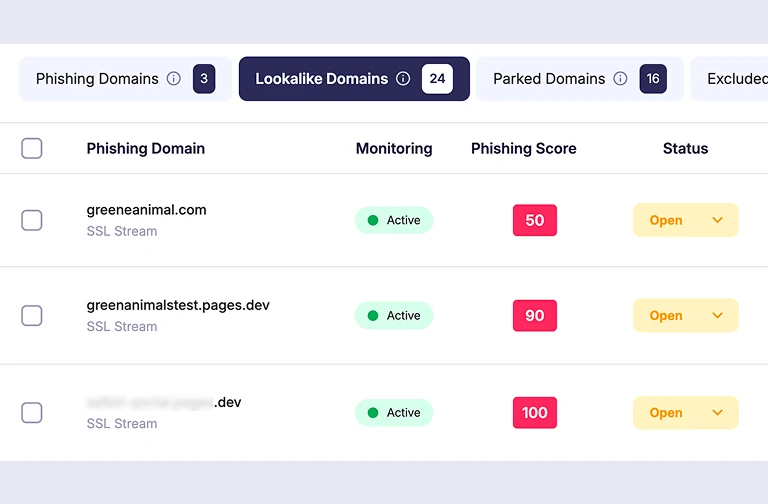
SOCRadar finds lookalikes across registrations and certificates, then checks the pages behind them. It says its phishing domain detection analyzes millions of domains across most major registrars, and that it watches newly registered domains and Certificate Transparency logs for brand lookalikes. KuppingerCole lists typosquatting and homoglyph patterns among SOCRadar's domain signals. 1–2,4,24–25
Website checks cover live status, login forms, HTML titles and text matches, and logo detection with OCR flags pages that copy your brand. KuppingerCole reports that the evidence for each SOCRadar detection includes screenshots of the offending content. No public documentation of isolated browsing, or of mail-readiness checks on lookalike domains, was found. 1–3,25
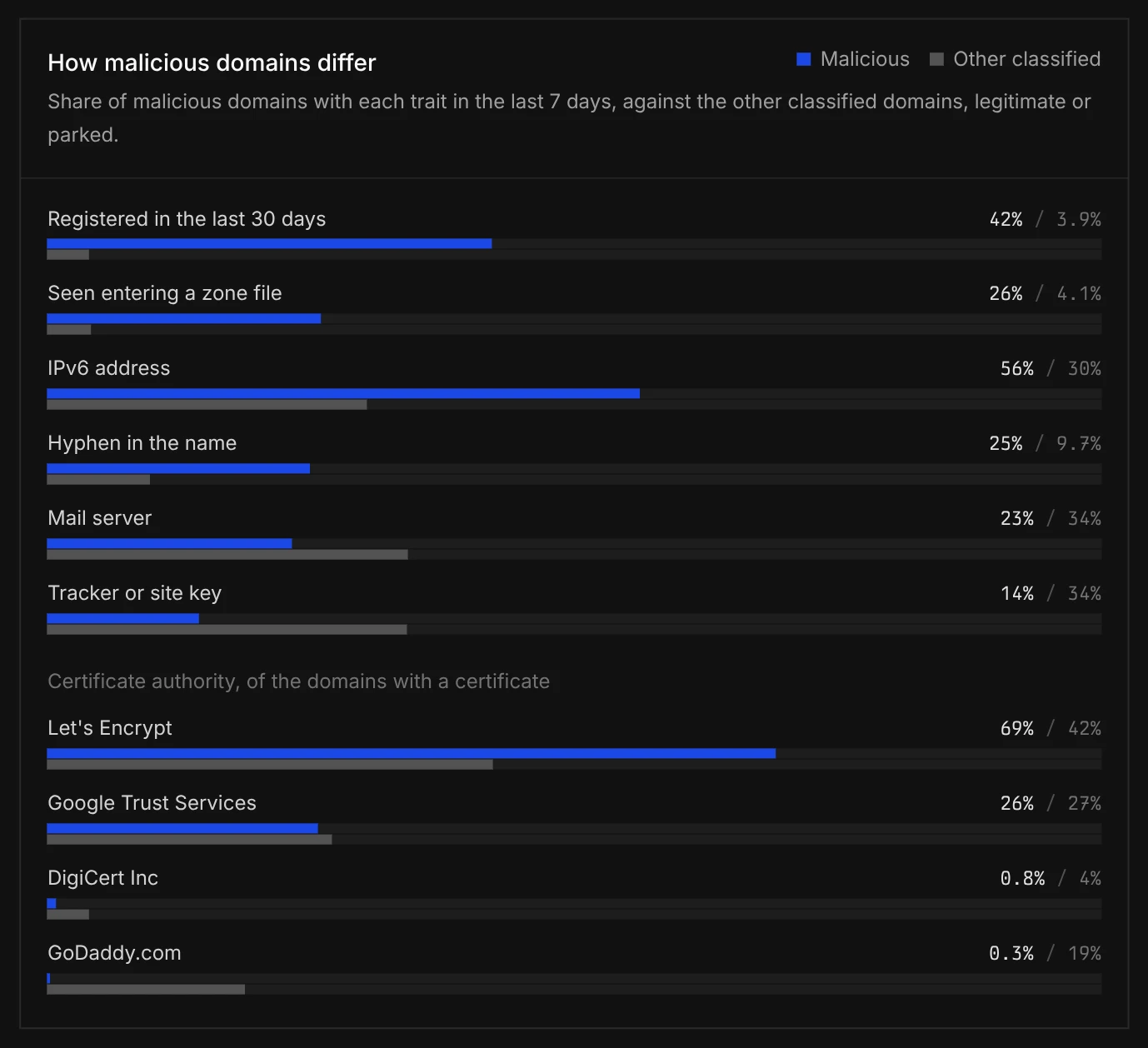
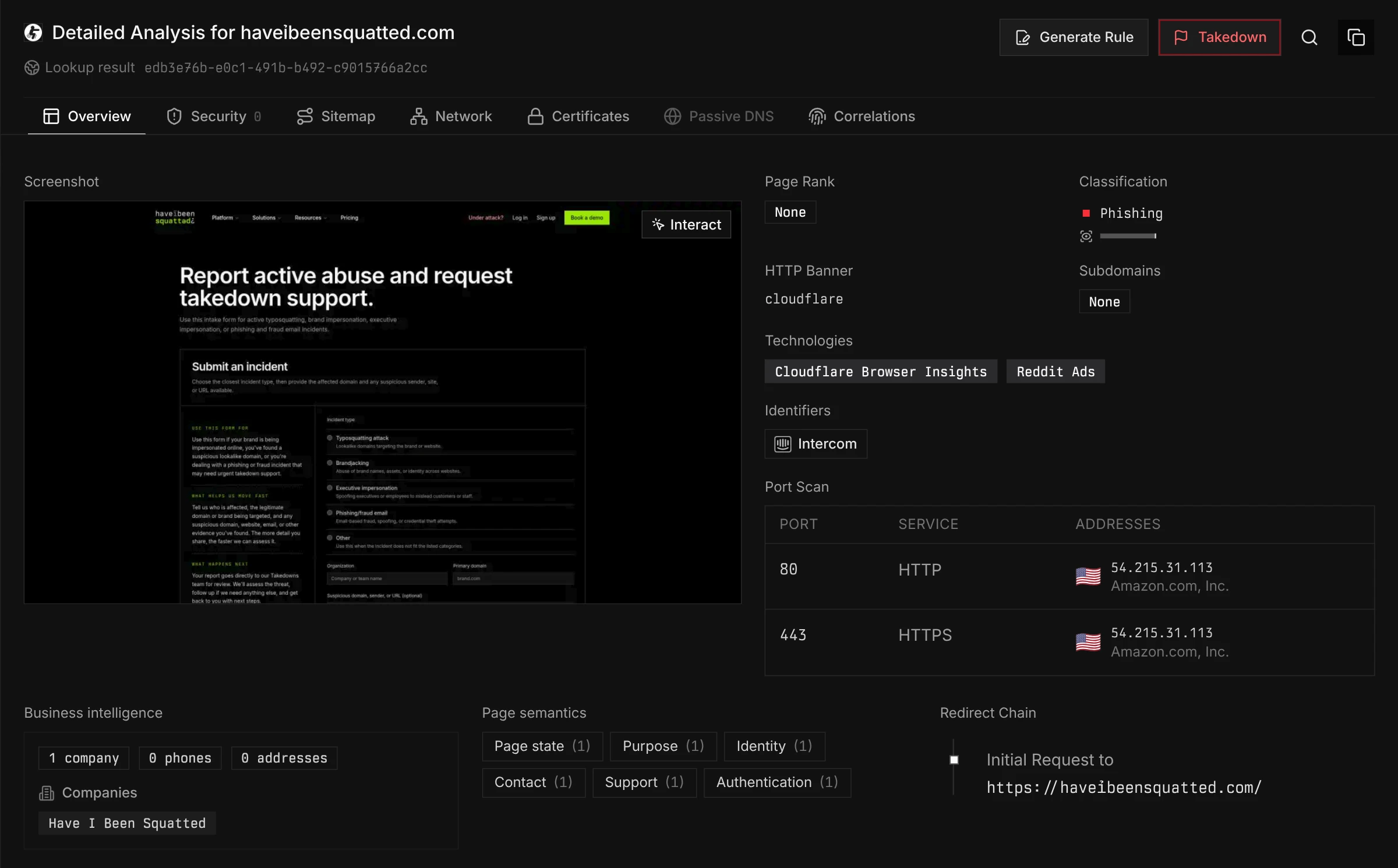
Have I Been Squatted gives your analysts the domain evidence to inspect. Discovery combines generated lookalikes, with named kinds such as homoglyphs, bitsquats and TLD swaps, with certificate transparency and newly registered domains. A result can include RDAP registration data, hosting details, DNS records, mail readiness, open ports and a website capture. An analyst can check whether a lookalike resolves, is set up for email or serves a copied page, then open it in an isolated browser. 6–9,11,20,23,36–40
To trace a campaign past one domain, SOCRadar describes a Phishing Master Agent that follows a phishing site's fingerprints to the rest of its infrastructure. Agent skills cover brand impersonation campaigns and indicator intelligence. 3
Have I Been Squatted handles that work in Atlas investigations, which are in early access. Describe what to hunt, optionally with domains you already suspect, and Atlas pivots across shared infrastructure in its store of domain observations. An admin can add indicators such as IP addresses, nameservers or favicon hashes for it to follow. Atlas keeps watching after the first leads run out, and an analyst reviews the results in views such as Tree, Table, Clusters and Flows. Results export as STIX 2.1, CSV or JSON. 28,39–44
Acting on a finding in your own tools#
SOCRadar's integration catalog covers SIEM, SOAR, chat and ticketing tools, including Splunk, Microsoft Sentinel, Tines, Slack, Teams and ServiceNow, and SOCRadar claims more than one hundred platform integrations. It also offers Brand Protection and Takedown APIs, custom AI-agent workflows, a visual workflow builder and an MCP server that works with Claude. Its catalog names firewalls from Palo Alto Networks, Fortinet, Check Point and Cisco. No public documentation of what those firewall integrations push was found. 1–3,25–26,45–46
Have I Been Squatted puts response in rules that run over domain signals. A maintained rules library covers common detections, and your team can add its own rules. A rule can raise an alert, deliver the finding to a SIEM, push the domain to a block list, annotate the result with a status such as Malicious, or request a Takedown. Network Enforcement sends flagged domains to gateways, endpoints, mail filters and a hosted domain feed. 6,10–20
An analyst or an agent can also respond without a rule. Dispatch Response sends one notification, SIEM finding or block for a single domain result at once. The Have I Been Squatted MCP server covers lookups, monitoring queries, rules, alerts, Takedowns, response dispatch, result annotation and documentation search, and every write needs an organization admin. 21–22,43,47–48
Takedowns
Follow a Takedown from request to outcome.
A demo shows the Takedown case workflow and the Network Enforcement gateways that receive blocks.
Managed takedowns and their targets#
Both products run managed takedowns, and SOCRadar covers more kinds of target. Its dedicated takedown team works with hosting providers, registrars and platforms on impersonating domains, social accounts, rogue mobile apps, fraud and scam pages, and code-repository content. Requests go through one-click submission and a management panel with detailed tracking, and SOCRadar re-monitors removed assets and shares domains with partners such as Google Web Risk. KuppingerCole describes takedown requests as a credit-based consumption model, and no public vendor figure for credit cost, quota or turnaround was found. 1–2,4,25,45,49
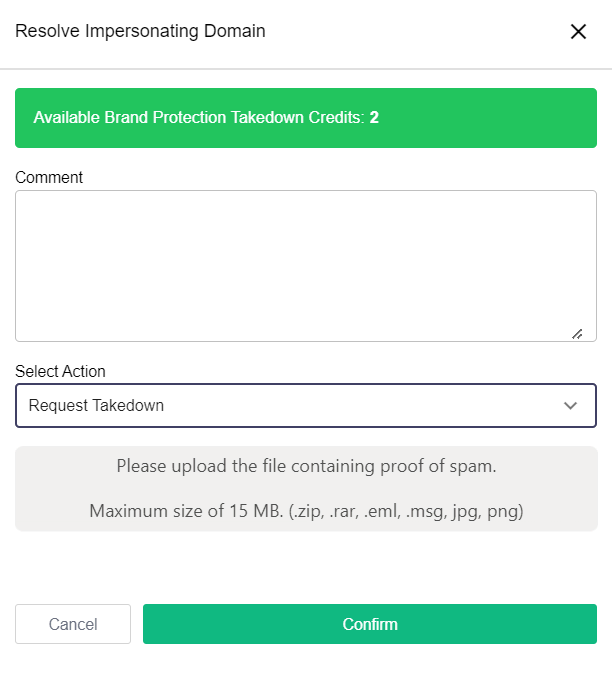
Have I Been Squatted runs managed Takedowns for domains. An analyst reviews every request, and a rule can open a request automatically. The team reports the domain to its host and registrar, then escalates to ICANN and regional CSIRTs where necessary, and stops short of legal action. Each request has a case record with its status through review and provider notification, plus analyst notes. 20,27–29
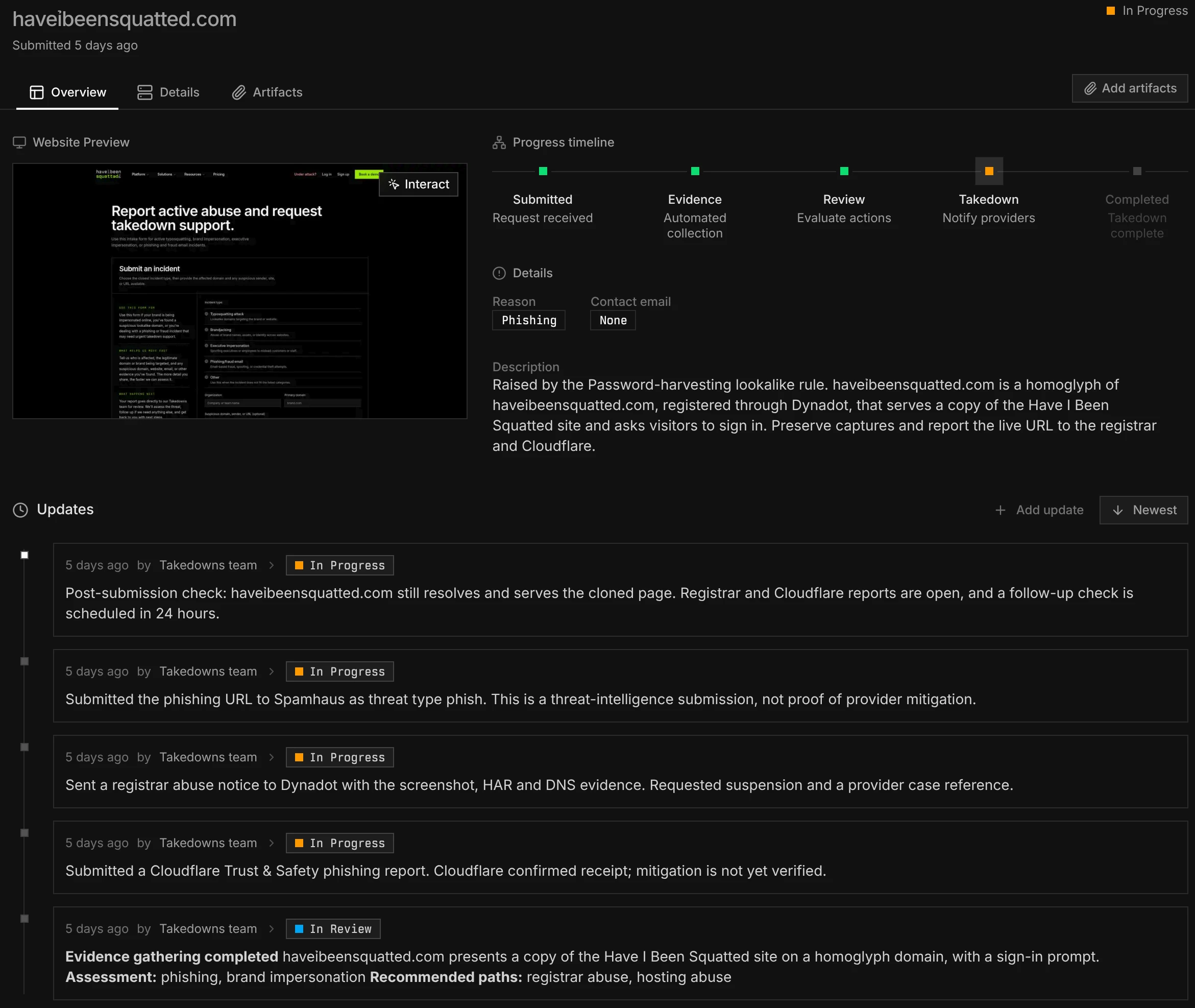
Choose SOCRadar when a case can move from a domain to a social profile, an app or a repository file. Choose Have I Been Squatted when the case is a malicious domain and you want the Takedown tied to the monitoring and rules that found it. 1–2,4,6,10–12,20,27–29
Where SOCRadar is the better choice#
SOCRadar fits when digital risk spans channels that a domain product does not cover. Social impersonation, rogue apps, dark-web monitoring, stolen-card detection for banks, code-repository abuse, attack-surface management, threat intelligence and third-party risk sit in one modular platform. Brand Protection also ships an Anti-Phishing Web Token that detects cloned page code, and logo matching that SOCRadar builds on SSIM, ORB, CLIP and vision models. 1–3
It also suits buyers who want a managed takedown team across those channels, a large named integration catalog, and an MSSP multi-tenant console and APIs. SOCRadar publishes SOC 2 Type II and ISO 27001 status, with Google Cloud hosting in EU and US regions. Its dark-web monitoring and threat-intelligence modules sell through public self-serve checkout, while Brand Protection is quote-based. A free account with no expiration date lets a team explore the platform with a business email. 1–2,26,45,50–53
Where Have I Been Squatted is the better choice#
Choose Have I Been Squatted when your team hunts malicious domains and the infrastructure behind them, and wants detection logic it can read and edit. Rules are written in the Upsilon query language over a catalog of 173 domain signals, or taken from a maintained library. A matching rule can alert in Slack, record the finding in a SIEM, block the domain in Zscaler, iboss or Microsoft Defender for Endpoint, or request a Takedown. Network Intelligence then shows whether devices on your network connected to a flagged domain. 5–6,10–20,54
Results also carry the checks an email security team asks for. They show MX records and an SMTP banner where the domain has them. Email Intelligence correlates Microsoft 365 or Google Workspace mail telemetry, including sender and URL domains, with your monitored domains. When a domain serves a site, an analyst can open a live, isolated browser session and interact with the page, and Analyze runs a one-off check on any domain you enter. 6–9,11,20–22,32–33,55–56
Getting started does not need a quote. Domain Monitoring checks your domains continuously, and Have I Been Squatted states that each gets a lookup at least once every 24 hours. Monitoring, hunting tools, rules and alerts start with a free trial, and Takedowns and the email, network, SIEM and canary products are bought through sales. Results leave as PDF reports, such as the "Domain security overview" and "Compliance readout", or as CSV and JSON exports. Have I Been Squatted has a SOC 2 Type II report, available through its Trust Center, and offers single sign-on and audit logging with Admin and Member roles. 7,9–10,20–23,28,39,43–44,54,57–58
Have I Been Squatted does not suit a buyer who wants one vendor for social, app, dark-web and vendor-risk work beside domains. SOCRadar covers that remit in one platform. 1,30–31
FAQ#
Have I Been Squatted offers a 14-day free trial, then a public self-serve subscription for Domain Monitoring, hunting tools, rules and alerts. Takedowns and the email, network, SIEM and canary products are bought through sales. SOCRadar offers a free account with no expiration date for a business email. No public documentation of the Brand Protection limits in that free account was found, and Brand Protection itself is quote-based. 1,7,20,53–54
Sources and corrections
Each numbered marker on this page links to its sources below. Each source shows the date it was last checked. If a fact is wrong or out of date, send a correction. A correction is checked against the source and the page is updated.
- 1.SOCRadar. “Extended Threat Intelligence plans & pricing (WB 2026-10-25).” Accessed . https://web.archive.org/web/20261025063447/https://socradar.io/pricing/
- 2.SOCRadar. “Brand Protection (WB 2026-10-25).” Accessed . https://web.archive.org/web/20261025063447/https://socradar.io/products/brand-protection/
- 3.SOCRadar. “SOCRadar AI Agents, Social Media Master Agent (WB 2026-10-23).” Accessed . https://web.archive.org/web/20261023183958/https://socradar.io/ai-agents/
- 4.SOCRadar. “Phishing Domain Detection (WB 2026-07-11).” Accessed . https://web.archive.org/web/20260711212606/https://socradar.io/solutions/phishing-domain-detection/
- 5.Have I Been Squatted. “Homepage (footer tagline).” Accessed . https://haveibeensquatted.com/
- 6.Have I Been Squatted. “Domain signals.” Accessed . https://docs.haveibeensquatted.com/reference/signals/domain/
- 7.Have I Been Squatted. “Domain Monitoring.” Accessed . https://haveibeensquatted.com/platform/monitoring
- 8.Have I Been Squatted. “Platform.” Accessed . https://haveibeensquatted.com/platform
- 9.Have I Been Squatted. “Access control reference.” Accessed . https://docs.haveibeensquatted.com/reference/access-control/
- 10.Have I Been Squatted. “Rules engine guide.” Accessed . https://docs.haveibeensquatted.com/guides/rules-engine/
- 11.Have I Been Squatted. “Changelog.” Accessed . https://haveibeensquatted.com/changelog
- 12.Have I Been Squatted. “Network Intelligence guide.” Accessed . https://docs.haveibeensquatted.com/features/network-intelligence/
- 13.Have I Been Squatted. “Integrations.” Accessed . https://haveibeensquatted.com/platform/integrations
- 14.Have I Been Squatted. “Alert digest guide.” Accessed . https://docs.haveibeensquatted.com/guides/digest/
- 15.Have I Been Squatted. “Connectors.” Accessed . https://docs.haveibeensquatted.com/integrations/
- 16.Have I Been Squatted. “Network Enforcement.” Accessed . https://haveibeensquatted.com/platform/network-enforcement
- 17.Have I Been Squatted. “Domain feed integration.” Accessed . https://docs.haveibeensquatted.com/integrations/domain-feed/
- 18.Have I Been Squatted. “CrowdStrike Falcon integration.” Accessed . https://docs.haveibeensquatted.com/integrations/crowdstrike-falcon/
- 19.Have I Been Squatted. “Microsoft Defender for Endpoint integration.” Accessed . https://docs.haveibeensquatted.com/integrations/microsoft-defender-endpoint/
- 20.Have I Been Squatted. “Pricing.” Accessed . https://haveibeensquatted.com/pricing
- 21.Have I Been Squatted. “Agents.” Accessed . https://haveibeensquatted.com/platform/agents
- 22.Have I Been Squatted. “MCP server.” Accessed . https://docs.haveibeensquatted.com/ai/mcp/
- 23.Have I Been Squatted. “Domain monitoring guide.” Accessed . https://docs.haveibeensquatted.com/features/domain-monitoring/
- 24.SOCRadar. “Insurance.” Accessed . https://socradar.io/industries/insurance/
- 25.KuppingerCole Analysts AG (vendor-hosted copy). “Buyer's Compass: Brand Protection, Vendor Spotlight (p. 13).” Accessed . https://socradar.io/wp-content/uploads/2026/03/BC_SOCRadar.pdf
- 26.SOCRadar. “Integrations (WB 2026-10-16).” Accessed . https://web.archive.org/web/20261016205230/https://socradar.io/integrations/
- 27.Have I Been Squatted. “Takedowns.” Accessed . https://haveibeensquatted.com/platform/takedowns
- 28.Have I Been Squatted. “Takedowns guide.” Accessed . https://docs.haveibeensquatted.com/features/takedowns/
- 29.Have I Been Squatted. “FAQ (stalled takedowns).” Accessed . https://haveibeensquatted.com/faq#takedowns-stall
- 30.Have I Been Squatted. “Solutions.” Accessed . https://haveibeensquatted.com/solutions
- 31.Have I Been Squatted. “Brand protection.” Accessed . https://haveibeensquatted.com/solutions/brand-protection
- 32.Have I Been Squatted. “Email Intelligence guide.” Accessed . https://docs.haveibeensquatted.com/features/email-intelligence/
- 33.Have I Been Squatted. “Email Intelligence.” Accessed . https://haveibeensquatted.com/platform/email-intelligence
- 34.SOCRadar. “Modules (WB 2026-10-12).” Accessed . https://web.archive.org/web/20261012083636/https://socradar.io/modules/
- 35.Have I Been Squatted. “Site Canaries guide.” Accessed . https://docs.haveibeensquatted.com/features/site-canaries/
- 36.Have I Been Squatted. “Atlas observations: registration data by TLD.” Accessed . https://mcp.haveibeensquatted.com/mcp
- 37.Have I Been Squatted. “Passive DNS guide.” Accessed . https://docs.haveibeensquatted.com/features/passive-dns/
- 38.Spamhaus. “Spamhaus passive DNS endpoint, unauthenticated probe.” Accessed . https://beta-pdns.spamhaus.com/api/v3/login
- 39.Have I Been Squatted. “Atlas investigations.” Accessed . https://docs.haveibeensquatted.com/features/atlas-investigations/
- 40.Have I Been Squatted. “Atlas investigations (add domains and indicators).” Accessed . https://docs.haveibeensquatted.com/features/atlas-investigations/#steer-an-investigation
- 41.Have I Been Squatted. “Atlas investigations (shareable view links).” Accessed . https://docs.haveibeensquatted.com/features/atlas-investigations/#read-the-map
- 42.Have I Been Squatted. “Atlas investigations (New investigation flow).” Accessed . https://docs.haveibeensquatted.com/features/atlas-investigations/#start-an-investigation
- 43.Have I Been Squatted. “Reports guide.” Accessed . https://docs.haveibeensquatted.com/features/reports/
- 44.Have I Been Squatted. “Explore guide.” Accessed . https://docs.haveibeensquatted.com/features/explore/
- 45.SOCRadar. “SOCRadar APIs (WB 2026-10-16).” Accessed . https://web.archive.org/web/20261016144905/https://socradar.io/socradar-apis/
- 46.SOCRadar. “SOCRadar MCP Server (WB 2026-10-15).” Accessed . https://web.archive.org/web/20261015144747/https://socradar.io/socradar-mcp-server/
- 47.Have I Been Squatted. “Slack app.” Accessed . https://docs.haveibeensquatted.com/ai/slack/
- 48.Have I Been Squatted. “MCP server (OAuth scopes).” Accessed . https://docs.haveibeensquatted.com/ai/mcp/#oauth-scopes
- 49.SOCRadar. “Integrated Takedown (WB 2026-10-25).” Accessed . https://web.archive.org/web/20261025063443/https://socradar.io/products/brand-protection/integrated-takedown/
- 50.SOCRadar. “Managed Security Service Providers (WB 2026-10-19).” Accessed . https://web.archive.org/web/20261019165046/https://socradar.io/partners/managed-security-service-providers/
- 51.SOCRadar. “Compliance (WB 2026-10-23).” Accessed . https://web.archive.org/web/20261023184005/https://socradar.io/compliance/
- 52.SOCRadar. “Trust Center (WB 2026-10-17).” Accessed . https://web.archive.org/web/20261017032546/https://trust.socradar.io/
- 53.SOCRadar. “Free Edition (WB 2026-10-16).” Accessed . https://web.archive.org/web/20261016182745/https://socradar.io/start-free/
- 54.Have I Been Squatted. “Network Intelligence.” Accessed . https://haveibeensquatted.com/platform/network-intelligence
- 55.Have I Been Squatted. “API: Analyze a URL.” Accessed . https://docs.haveibeensquatted.com/guides/api/analyze/#analyze-a-url
- 56.Have I Been Squatted. “Tools: Analyze (URL analysis note, served without sign-in).” Accessed . https://haveibeensquatted.com/app/tools?mode=analyze
- 57.Have I Been Squatted. “Security.” Accessed . https://haveibeensquatted.com/about/security
- 58.Have I Been Squatted. “Administration guide.” Accessed . https://docs.haveibeensquatted.com/guides/administration/
- 59.Have I Been Squatted. “Webhooks.” Accessed . https://docs.haveibeensquatted.com/integrations/webhooks/